Salesforce Data 360: real business use cases by industry

In 2025, Salesforce Data Cloud was rebranded to Data 360, marking more than a simple name update. The shift reflects a broader vision: moving from a customer data platform concept to a complete enterprise data foundation inside Salesforce.
In this guide, you will learn:
- What is Data 360, and how does it work,
- How Data 360 Salesforce differs from traditional CDPs
- Salesforce Data 360 use cases across industries,
- The business impact of implementing Salesforce Data 360.
If you previously worked with Salesforce Data Cloud, understanding the transition to Data 360 is essential. The core technology remains, but the positioning and strategic role within Salesforce have expanded.
What is Salesforce Data 360?
Salesforce Data 360 is a real-time data layer built into the Salesforce platform. It unifies customer data from multiple systems, resolves identities across channels, and activates that data across Sales, Service, Marketing, and Commerce. Instead of storing information in separate tools, Data 360 connects it into one consistent view.
Many companies still struggle with fragmented systems, delayed reporting, and inconsistent customer records. Data 360 addresses these issues by creating a single, continuously updated profile for each customer, account, or partner. That profile can then power segmentation, automation, forecasting, AI models, and decision-making across teams.
Why was Salesforce Data Cloud renamed to Data 360 in 2025?
In 2025, Salesforce officially repositioned Salesforce Data Cloud as Data 360. Many companies still search for terms such as Salesforce Data Cloud, so it is important to clearly explain what actually changed.
The short answer is simple. No new platform replaced the previous one. The technology foundation remains the same. The shift clarified its strategic role inside the Salesforce ecosystem.
The name “Salesforce Data Cloud” reflected its origins as a customer data platform focused mainly on unifying marketing data. The name Data 360 signals a broader ambition. It highlights a complete, end-to-end data layer designed to support every cloud and every team working in Salesforce.
What changed in Data 360 compared to Salesforce Data Cloud
1. The name
Salesforce Data Cloud is now branded as Data 360. References to Data Cloud in older materials generally point to the same platform under its previous name.
2. The positioning
The platform evolved from being positioned primarily as a CDP to being presented as an enterprise-wide data foundation. Data 360 is described as the layer that connects all customer, account, and operational data across the organization.
3. The scope of impact
Messaging now emphasizes cross-cloud operational value, not only marketing activation. Data 360 now supports:
- Sales prioritization and pipeline insights,
- Service case context and faster resolution,
- AI model training and predictive scoring,
- Compliance monitoring and reporting,
- Enterprise analytics across departments.
The emphasis shifted from campaign performance to enterprise data intelligence.
What remained the same in Data 360 Salesforce
While positioning expanded, core capabilities remained stable:
- The same ingestion framework for structured and unstructured data,
- Identity resolution logic that connects records across systems,
- Profile unification creating persistent, continuously updated views,
- Activation across Sales, Service, Marketing, and other Salesforce products.
Organizations that previously implemented Salesforce Data Cloud continue operating on the same technical base under the Data 360 name. No rebuild is required solely because of the rebrand.
Why the rebrand matters
The renaming reflects how companies are actually using the platform today. Many organizations moved beyond marketing use cases and began relying on unified data for operational workflows, AI initiatives, and decision support across teams.
Data 360 is no longer framed as an optional marketing layer. It is positioned as a core infrastructure component inside Salesforce. For decision-makers evaluating investments in data architecture, that distinction is important.
Understanding the shift helps leadership teams assess Data 360 correctly. It is not a new product launch, but it represents a clearer strategic direction: one integrated data layer supporting the entire Salesforce ecosystem.
How Data 360 works
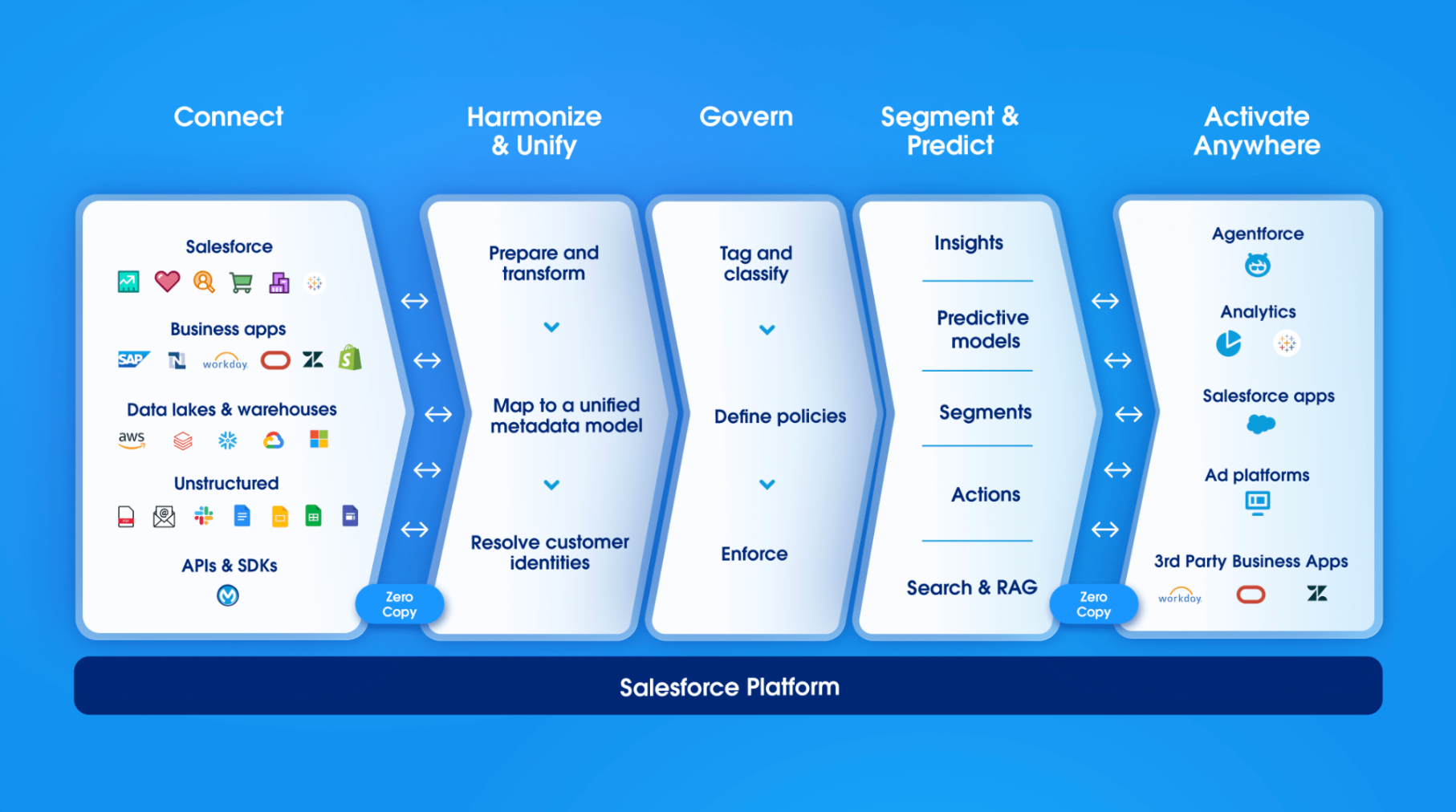
Salesforce Data 360 functions as a native activation engine inside Salesforce. It does not simply store data. It makes enterprise data usable across applications, workflows, analytics, and AI agents without forcing companies to rebuild complex pipelines.
The process operates in four connected stages.
1. Data ingestion and Zero Copy integration
Data 360 connects structured and unstructured data from across the enterprise.
Sources include:
- Salesforce applications,
- Data warehouses,
- Data lakes,
- ERP systems,
- Product telemetry streams,
- Websites and mobile apps,
- Documents such as reports, emails, and PDFs.
Through Zero Copy integration, data can remain in its original warehouse while still being accessible inside Salesforce. This removes the need for duplicating large datasets or maintaining heavy synchronization pipelines.
Pre-built connectors and the Zero Copy Partner Network allow organizations to bring in data from over 200 sources. Both historical data and streaming signals can be ingested. The result is a single access layer that prepares enterprise data for activation without unnecessary movement.
2. Identity resolution and harmonization
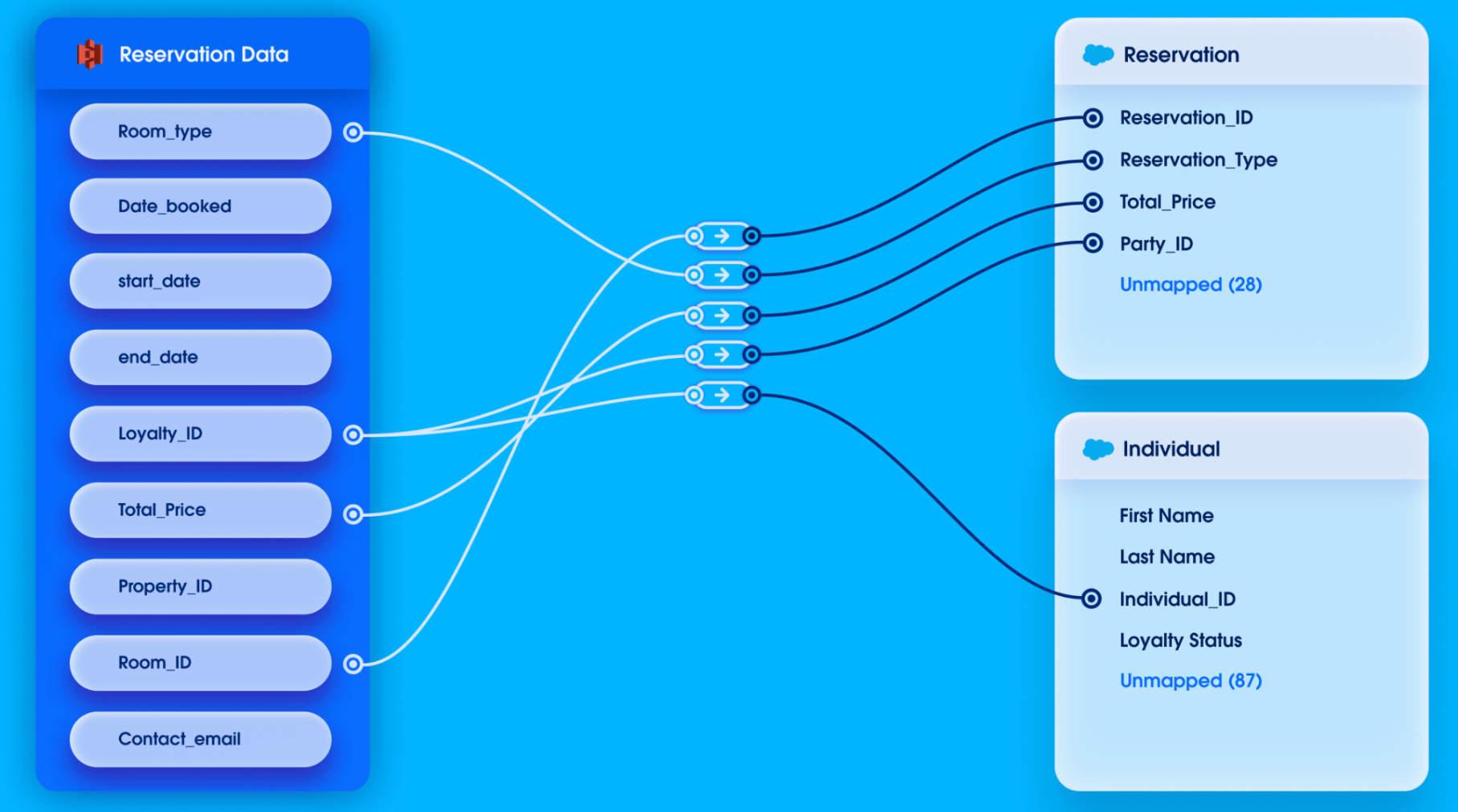
Once data is connected, Data 360 harmonizes it using a unified data model integrated with the Salesforce metadata framework.
Metadata defines how objects such as Accounts and Contacts relate to each other. By mapping external data to this framework, Data 360 ensures that all information follows consistent logic inside Salesforce.
Identity resolution then connects:
- CRM records,
- Transaction histories,
- Behavioral data,
- Device signals,
- Communication history.
Deterministic and probabilistic matching help consolidate records that refer to the same person or organization. The output is a structured, resolved dataset ready for unified profiling.
3. Profile unification and enrichment
After harmonization, Data 360 creates persistent unified profiles. Each profile can include:
- Demographics,
- Purchase data,
- Engagement activity,
- Service interactions,
- Subscription details,
- Behavioral signals.
Data 360 also processes unstructured documents. Reports, emails, and other text-based materials can be transformed into structured insights that AI agents can interpret and use.
Profiles update continuously. With sub-second real-time processing, changes in behavior or transactions can immediately influence workflows.
Calculated Insights, Segments, and Predictive Models can be built directly on unified profiles. These insights can surface on standard Salesforce objects and trigger automations through Flow.
4. Activation across workflows, analytics, and AI
The final stage is activation. Data 360 powers:
- Sales prioritization,
- Real-time segmentation,
- Service case enrichment,
- Commerce personalization,
- Cross-cloud reporting,
- Agentforce AI workflows.
Because Data 360 is native to Salesforce, unified data can be used directly within object records, automation flows, dashboards, and AI prompt templates.
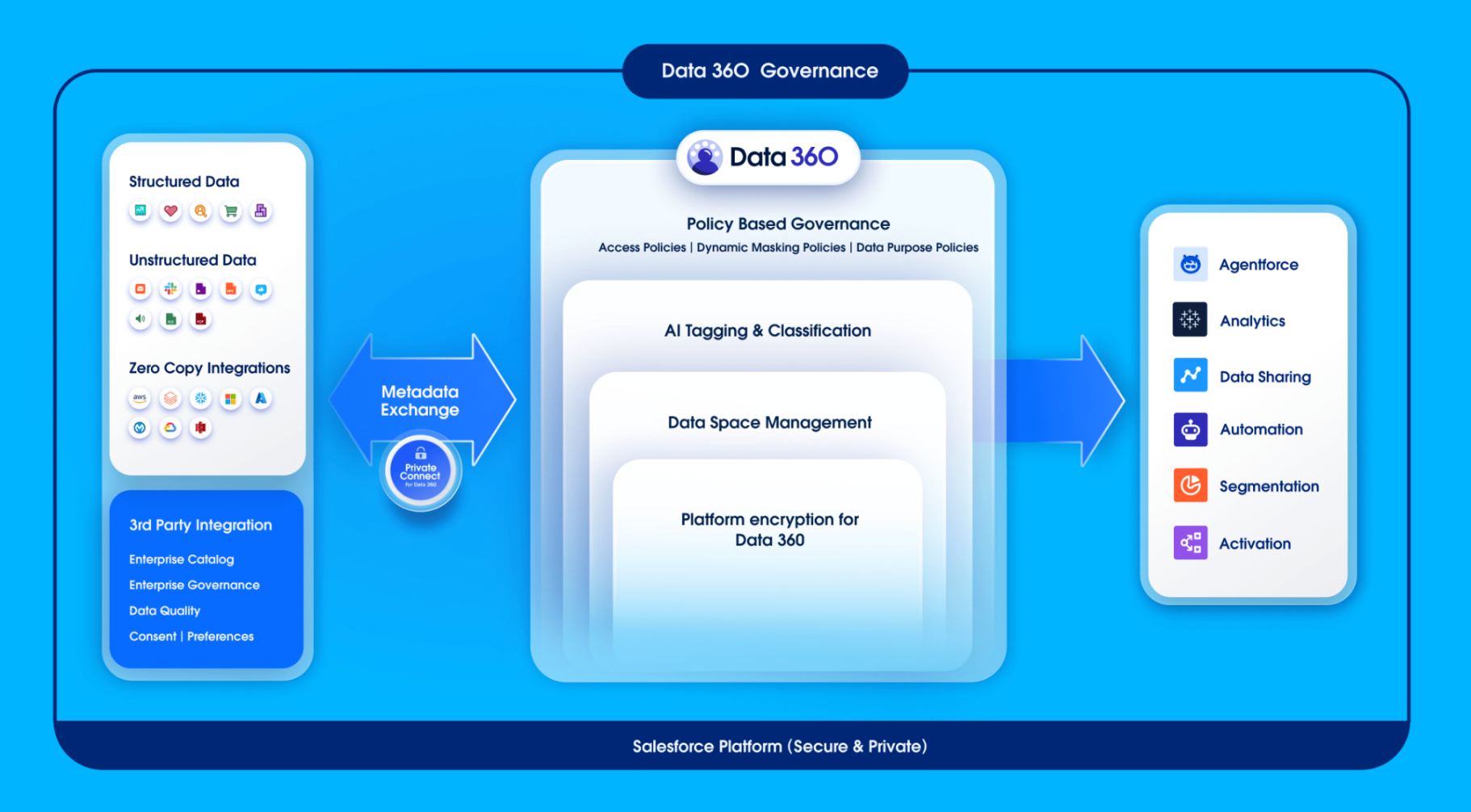
It also supports governance at scale:
- Policy-based access controls,
- Data masking,
- Secure private connections,
- Encryption key flexibility,
- Automated tagging and classification.
Every activation occurs within a governed framework, ensuring compliance and controlled access.
Data 360 acts as the trusted data foundation for Agentforce. Through retrieval mechanisms and contextual indexing, AI agents can access structured and unstructured knowledge with relevant filtering and ranking.
How Data 360 differs from traditional CDPs
Many organizations still view Data 360 only through the lens of a customer data platform. While Data 360 is recognized as a leading CDP for marketers, its scope is significantly broader.
What Traditional CDPs typically do
Their primary purpose is campaign activation:
- Focus on marketing segmentation,
- Export audiences to campaign tools,
- Operate as standalone platforms,
- Require separate governance frameworks,
- Duplicate data into proprietary storage.
Data 360 Salesforce model
1. Native architecture
Data 360 is embedded directly in Salesforce. It integrates with the metadata framework, object model, automation tools, and analytics products without requiring external orchestration layers.
2. Enterprise activation layer
It supports marketing, sales, service, commerce, analytics, and AI equally. Data flows into operational workflows, not just campaign audiences.
3. Zero Copy foundation
Unlike many CDPs that replicate data, Data 360 enables access without forcing full data movement. Structured and unstructured data from warehouses and lakes can be activated inside Salesforce directly.
4. AI-ready infrastructure
A major limitation of traditional systems is the lack of context for AI. Studies show that many generative AI pilots fail due to fragmented and unreliable data inputs.
Data 360 addresses this by:
- Unifying fragmented data sources,
- Enriching structured and unstructured content,
- Indexing information for contextual retrieval,
- Providing governed access controls.
AI agents such as Agentforce rely on trusted context. Data 360 provides that foundation.
Data 360 vs traditional Customer Data Platforms (CDPs)
| Feature | Salesforce Data 360 | Traditional CDP |
|---|---|---|
| Native to Salesforce | Yes: built into the Salesforce platform | No: usually external tools |
| Data activation scope | Enterprise-wide: Sales, Service, Marketing, Commerce, AI | Primarily marketing and campaign audiences |
| Data integration method | Zero Copy + connectors to warehouses, apps, lakes | Requires ETL/ELT pipelines or data replication |
| Unstructured data support | Yes: processes documents, emails, reports | Limited or requires separate tools |
| Unified identity and governance | Centralized within the Salesforce metadata framework | Often separate, less governed |
| AI readiness | High: data indexed for contextual AI use | Moderate: focuses on segment output |
| Real-time updates | Sub-second processing and streaming | Batch or near-real-time at best |
| Security, compliance controls | Policy-based access, masking, encryption | Varies by vendor, often separate systems |
| Activation endpoints | Salesforce apps + workflows + analytics + AI | Marketing tools; limited operational endpoints |
Salesforce Data 360 use cases by industry
Below are practical Data 360 Salesforce use cases across industries. While the technical foundation remains the same, the way companies apply Data 360 depends on their operational model, customer journey complexity, and regulatory environment.
Retail and eCommerce
Retailers operate in real time. Customers browse, compare, abandon carts, return later, and switch devices. Yet many brands still rely on disconnected data from eCommerce platforms, loyalty systems, marketing tools, and POS systems.
With Salesforce Data 360, browsing behavior, purchase history, in-store transactions, and campaign engagement are unified into one continuously updated profile. When a customer interacts with a product page or leaves a cart behind, that signal becomes immediately visible across Salesforce. Marketing segments update dynamically. Sales teams can prioritize high-intent buyers. Service agents see full purchase context without asking repetitive questions.
Instead of reacting hours or days later, retailers can personalize offers at the exact moment intent is strongest. The outcome is more consistent customer experiences, smarter cross-sell opportunities, and improved conversion performance across channels.
Financial services
Banks and financial institutions manage vast datasets across core banking systems, advisory tools, compliance platforms, and CRM environments. Advisors often lack a complete picture of client activity, which limits their ability to provide proactive recommendations.
Data 360 brings transaction history, engagement data, service interactions, and product holdings into a unified advisor view. Instead of switching between systems, advisors access consolidated client profiles inside Salesforce. That profile can include behavioral signals, financial product usage, and communication history.
Risk segmentation also becomes more refined. By analyzing unified behavioral and transactional data, institutions can better identify patterns that indicate fraud risk, product eligibility, or cross-sell potential. Governance controls ensure that sensitive financial information remains protected while still usable within workflows.
The result is more informed client conversations, improved product penetration, and stronger alignment between compliance, sales, and service teams.
Healthcare and life sciences
Healthcare organizations and life sciences companies often struggle with fragmented patient engagement data. Appointments, call center interactions, portal activity, and outreach campaigns frequently live in separate systems.
Salesforce Data 360 connects these touchpoints into one structured engagement timeline. Communication history, case interactions, and digital activity become accessible in a unified profile. Even unstructured documents such as reports or correspondence can be processed and indexed for contextual insight.
Care teams gain better visibility into patient journeys. Outreach can be timed more precisely. Service representatives reduce repetition because they understand prior interactions before responding.
For regulated industries, centralized governance ensures that sensitive patient data remains controlled and compliant, while still supporting operational workflows and analytics.
SaaS and technology
Technology companies generate large volumes of product usage data. Feature adoption, login frequency, subscription changes, and support activity often remain in warehouses disconnected from CRM systems.
With Data 360, usage telemetry flows into Salesforce without requiring complex duplication pipelines. Accounts and contacts can be enriched with behavioral metrics in near real time. Segments can be built around adoption levels, inactivity thresholds, or expansion readiness.
Streaming insights allow companies to detect behavioral patterns in real time. Automated actions powered by unified data reduce manual effort and improve responsiveness. Through scalable integration approaches such as Bring Your Own Data Lake, Salesforce Data 360 enables organizations to activate usage data inside Salesforce workflows.
Churn prediction improves when usage decline, billing signals, and support sentiment are analyzed together instead of in isolation. Customer success teams receive earlier indicators that intervention may be required. Sales teams identify accounts ready for upsell based on actual engagement patterns.
Rather than relying on static reports, SaaS organizations operate on continuously refreshed insights embedded directly into their workflows.
Travel, transportation, and hospitality
Travel and transportation companies manage complex customer journeys that span booking platforms, loyalty programs, mobile apps, service centers, and partner systems. Data fragmentation creates inconsistent guest experiences and limits operational visibility.
Air India improved agent productivity by providing real-time access to unified data. When customer details, travel history, and service interactions are available instantly, response times decrease, and engagement quality improves.
Shipping and logistics organizations, such as FedEx, leveraged streaming insights to identify international shipping interest based on web behavior. That level of real-time visibility supports proactive outreach rather than reactive support.
Automation also plays a critical role. Timely, data-driven communication reduces manual tasks and improves customer engagement.
For travel and hospitality brands, Salesforce Data 360 enables:
- Real-time personalization of offers and upgrades,
- Unified traveler or guest profiles across channels,
- Faster service resolution with complete interaction history,
- Scalable data processing as passenger and booking volumes grow.
When booking behavior, loyalty status, service requests, and digital engagement signals converge into one trusted profile, organizations respond faster and create more consistent experiences across the entire journey.
Cross-industry impact
Across sectors, external case studies demonstrate consistent efficiency improvements after consolidating fragmented data:
- Reduced data update times
- Increased repeat conversions
- Higher agent productivity
- Faster response times
- Improved engagement rates
Salesforce Data 360 transforms disconnected enterprise systems into a governed activation layer. Instead of letting data remain isolated, companies can power workflows, analytics, automation, and AI with trusted, real-time insight.
Benefits of Salesforce Data 360 implementation for your business
Implementing Salesforce Data 360 is not only a technical upgrade. It changes how teams operate, how decisions are made, and how AI systems perform. When enterprise data becomes unified and activation-ready, measurable business improvements follow.
Below are the core business benefits organizations typically experience after implementing Data 360.
A single, trusted source of truth
Many enterprises operate with disconnected systems and duplicated records. Marketing, sales, and service teams often rely on different datasets, which leads to conflicting reports and inconsistent customer communication.
Data 360 harmonizes structured and unstructured data into unified profiles mapped to Salesforce metadata. Teams access the same up-to-date information across clouds.
The impact:
- Consistent reporting across departments,
- Reduced duplication and manual reconciliation,
- Higher confidence in decision-making.
Faster decision-making with real-time data
Traditional systems rely on batch updates. That delay creates gaps between customer action and business response.
With sub-second real-time processing and streaming ingestion, Data 360 enables teams to react immediately. Behavioral signals, transactions, and engagement events update profiles continuously.
The impact:
- Quicker sales prioritization,
- More timely marketing activation,
- Improved service responsiveness.
Improved operational efficiency
Data fragmentation forces teams to switch between tools and manually validate information. That slows productivity and increases error risk.
Data 360 integrates unified data directly into Salesforce workflows, automation tools, and dashboards. Calculated insights and segments can trigger actions automatically through Flow.
The impact:
- Reduced manual data handling,
- Shorter processing times,
- Increased agent productivity,
- Lower operational costs.
Stronger personalization and engagement
Personalization depends on accurate, unified profiles. When engagement history, transactions, and preferences are scattered, targeting becomes generic.
Data 360 centralizes customer signals and enables dynamic segmentation across channels. AI-driven recommendations and contextual interactions become more reliable.
The impact:
- Higher engagement rates,
- Increased repeat conversions,
- Better customer lifetime value.
Better AI performance and automation
Many AI initiatives struggle because underlying data lacks context or reliability. Fragmented datasets produce inconsistent outputs.
Data 360 provides structured, governed, and enriched data that supports predictive models, automation logic, and AI agents. With unified context, AI systems generate more relevant and actionable results.
The impact:
- More accurate predictive insights,
- Smarter next-best-action recommendations,
- Improved automation precision.
Governance and compliance at scale
Enterprises must manage sensitive data responsibly. As data volume grows, so does regulatory risk.
Data 360 supports policy-based governance, data masking, encryption options, and controlled access management within the Salesforce environment.
The impact:
- Improved regulatory compliance,
- Reduced risk exposure,
- Centralized policy enforcement across structured and unstructured data.
Scalability for growing data ecosystems
As organizations expand, data volume and complexity increase. Traditional architectures struggle to scale without rising storage and integration costs.
Data 360’s flexible architecture and Zero Copy approach allow companies to activate large datasets without duplicating storage. External lakes and warehouses remain connected while data becomes operational.
The impact:
- Lower infrastructure overhead,
- Faster onboarding of new data sources,
- Scalable support for growing user bases and AI use cases.
Implement Data 360 Salesforce with the right partner
Technology alone does not create value. The architecture, data model, governance setup, and activation logic determine whether Salesforce Data 360 becomes a real business engine or just another platform layer.
At Noltic, we specialize in designing and implementing complex Salesforce ecosystems where data is central to operations.
Why companies choose Noltic for Data 360 projects
- 160+ Salesforce projects delivered across industries,
- 95+ certified Salesforce experts,
- 400+ Salesforce certifications across architecture, data, AI, and cloud specializations,
- 5 in-house AppExchange products,
- Experience across Sales Cloud, Service Cloud, Marketing Cloud, Revenue Cloud, Experience Cloud, and analytics,
- Proven track record in regulated industries such as finance, healthcare, logistics, and manufacturing.
- Perfect 5.0 review score on AppExchange and Clutch.
What we can help you with:
- Salesforce Data 360 architecture and roadmap design,
- Data ingestion and Zero Copy integration strategy,
- Unified profile modeling and identity resolution setup,
- Governance, compliance, and security configuration,
- Activation across Sales, Service, Marketing, and Agentforce,
- AI-ready data foundation for predictive models and automation.
If your organization is evaluating Salesforce Data 360 services or transitioning to Data 360, we can help you design a scalable and governed foundation that supports long-term growth.
FAQs about Salesforce Data 360
What is the first step before implementing Data 360?
The most important first step is defining the business outcome. Rather than starting with technology configuration, organizations should identify a clear use case such as churn reduction, personalization improvement, risk segmentation, or operational efficiency.
From there, teams can map required data sources, evaluate integration readiness, and design a phased rollout plan. A focused initial use case reduces complexity and demonstrates measurable value before scaling further.
How long does a Salesforce Data 360 implementation take?
Implementation timelines depend on data complexity, number of integrations, governance requirements, and activation scope.
A focused pilot use case may take a few weeks, especially if data sources are already structured. Enterprise-scale implementations involving multiple warehouses, identity resolution logic, and cross-cloud activation typically require a phased roadmap over several months.
Successful projects usually start with clear business priorities, defined data models, and a structured rollout plan that includes governance, activation design, and user enablement.
Does Salesforce Data 360 require moving all data into Salesforce?
No. One of the key architectural advantages of Data 360 is zero-copy access. Instead of physically duplicating large datasets inside Salesforce, organizations can securely connect to external warehouses and lakes.
This reduces storage costs, avoids data synchronization conflicts, and allows companies to keep sensitive or regulated data in its original environment while still activating it within Salesforce workflows.
Can Data 360 handle unstructured data like emails and documents?
Yes. Data 360 is designed to work with both structured data, such as transactions and CRM records, and unstructured data, such as emails, reports, PDFs, and knowledge articles.
Unstructured content can be processed, indexed, and transformed into structured insights. This is particularly important for AI-driven workflows, where context from documents improves decision accuracy and relevance.
.webp)



Salesforce Data Cloud explained: a guide to building a real-time customer data foundation

5 ways Salesforce Data Cloud activates customer information to fuel your business growth
together