Salesforce services for high-tech and SaaS companies
Helping SaaS, software, and technology companies build scalable Salesforce solutions that support growth, automate routine work, and give teams a complete view of customers, revenue, and operations.



Trusted by tech companies in the USA & Europe







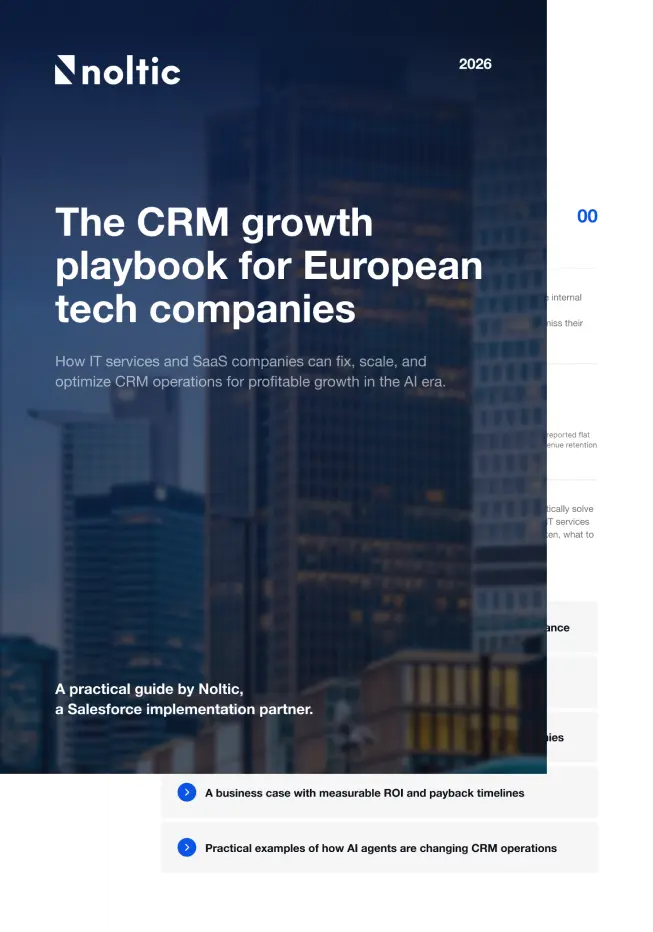
The CRM Growth Playbook for Technology Companies.
Created from 9+ years of hands-on CRM and Salesforce consulting, this guide combines real implementation experience, industry research, practical frameworks, and business cases to help SaaS and IT services companies build CRM systems that support long-term growth.
Download your free copy today
Download your free copy today
Why companies choose Noltic as a CRM implementation partner for high tech
Since 2017, we have helped SaaS, software, and IT services companies implement, customize, and scale Salesforce. From CRM implementation and data migration to integrations, Revenue Cloud, and custom development, our team delivers solutions built around your growth goals.
160+
delivered projects
95+
Salesforce certified experts
100+
5-star reviews on AppExchange
8
in-house products
Who benefits from Salesforce for High Tech?
SaaS companies managingsubscriptions & renewals
Track the full customer journey, automate renewals, identify upsell opportunities, and give customer success teams complete visibility into account health.
Startups preparing for rapid growth
Build scalable sales and operational processes early, reduce manual work, and create a CRM foundation that can support future expansion.
IT services providerswith complex sales cycles
Manage long sales processes, multiple stakeholders, partner relationships, and service delivery workflows from a single platform.
Software and product companies with disconnected system
Bring together customer, product, support, and revenue data to improve reporting, collaboration, and decision-making across teams.
Why Salesforce is the best CRM for a growing tech startup?
42% More accurate forecasting
Growing SaaS and technology companies need reliable revenue forecasts to plan hiring, investments, and expansion. Salesforce users report up to 42% higher forecast accuracy according to Salesforce research.
Less manual work through automation
91% of employees say automation saves them time, while 89% report higher job satisfaction because of automation. Salesforce automates routine processes so your teams can focus on customers, product development, and revenue-generating activities.
Built for the AI era
Salesforce combines CRM, automation, Data Cloud, and Agentforce capabilities on a single platform, giving companies a foundation for AI adoption without creating new data silos. More than 90% of organizations using AI report time and cost savings.
Here are the solutions Salesforce for tech brings to the table
We help you choose the right Salesforce solutions based on your business goals and operational challenges.
Struggling with long sales cycles and inconsistent forecasting?
01.
Sales Cloud
Give your sales team a single place to manage leads, opportunities, accounts, activities, and forecasts. Sales Cloud helps improve pipeline visibility, automate routine tasks, and create a more predictable sales process.
Managing subscriptions, renewals, and complexpricing?
02.
Revenue Cloud
Handle the entire quote-to-cash process from product configuration and pricing to contracts, billing, renewals, and revenue management. Revenue Cloud is particularly valuable for SaaS and subscription-based companies.
Finding it difficult to scale customer support?
03.
Service Cloud
Provide faster and more consistent customer service with case management, knowledge bases, omnichannel support, self-service portals, and AI-powered assistance for service teams.
Looking to improve lead generation and customer engagement?
04.
Marketing Cloud
Create personalized customer journeys across email, SMS, advertising, and digital channels. Marketing Cloud helps marketing and customer success teams engage customers at every stage of the lifecycle.
Working withdisconnected systemsand fragmented data?
05.
ETL & data integration services
Connect Salesforce with ERP systems, accounting platforms, product databases, support tools, data warehouses, and other business-critical applications to create a single source of truth across your organization.
Salesforce: top CRM features for tech companies' growth
Built as a modern CRM for tech companies, Salesforce helps SaaS, software, and IT organizations manage customer relationships, automate operations, and make better decisions with data and AI.
Pipeline management
Track every opportunity from lead to closed deal, manage complex sales cycles, and gain real-time visibility into pipeline performance and forecasted revenue.
AI forecasting and insights
Use AI CRM capabilities to identify risks, prioritize opportunities, predict revenue outcomes, and provide sales teams with actionable recommendations based on customer data.
Workflow automation
Automate lead assignment, approvals, follow-ups, onboarding tasks, renewals, and other repetitive processes to reduce manual effort and improve consistency.
Reporting and analytics
Access real-time dashboards and performance metrics across sales, customer success, marketing, and revenue operations to supportdata-driven decision-making.
Subscription & revenue management
A key advantage of Salesforce for SaaS companies is the ability to manage subscriptions, renewals, upgrades, usage-based pricing, and recurring revenue processes within a connected platform.
Customer 360 view
Bring together sales, support, marketing, billing, and product information to create a complete view of every customer across the entire lifecycle.
Customer success & retention tracking
Monitor account health, customer engagement, support activity, and renewal milestones to identify expansion opportunities and reduce churn risks.
Integrations and scalability
Connect Salesforce with ERP systems, accounting platforms, support tools, product analytics, and other business applications while supporting future growth without replacing your CRM.


Our Salesforce implementation process for technology companies
What you get with Noltic's Salesforce implementation services
Technology companies invest in Salesforce to create a foundation for sustainable growth. Our team helps you build a platform that supports your processes today and scales with your business tomorrow.
Fully implemented CRM
Align your sales, customer success, service, and operational processes.
Integrated technology stack
Connect Salesforce with your existing business applications and data sources.
Automated workflows
Reduce manual work and improve team productivity.
AI-powered insights
Support forecasting, prioritization, and decision-making.
Real-time reporting dashboards
Visibility into performance, revenue, and customer activity.
A trained and confident team
Ready to use Salesforce effectively from day one.
/ More news

October 28, 2026
Salesforce
Salesforce Service Cloud Voice: What It Does, What It Costs, and How to Set It Up
Salesforce Voice is the new name for Service Cloud Voice. Features, pricing, benefits, and more — find out everything you need to know.
Read more

October 23, 2026
Salesforce
How to Migrate from Pardot to Marketing Cloud Next in 10 Steps
Why migrate from Pardot to Marketing Cloud Next? And how do you do it in 10 steps? Find all the details in our guide.
Read more
/ Start a Salesforce project
Lets work together

FAQ
Why is Salesforce a good CRM for technology companies?
Salesforce is a leading CRM for technology companies because it combines sales, marketing, customer success, support, analytics, and AI capabilities on a single platform. Technology businesses can manage the entire customer lifecycle while maintaining a complete view of accounts, subscriptions, and revenue.
Is Salesforce a good choice for SaaS companies?
Yes. Salesforce for SaaS companies supports subscription management, renewals, customer onboarding, account expansion, forecasting, and customer success processes. As your business grows, Salesforce can scale alongside your sales and operational requirements.
How do Salesforce Marketing Cloud implementation partners help?
Salesforce Marketing Cloud implementation partners handle the full setup, from architecture and configuration to integrations and automation. They ensure your system is scalable, your data is structured correctly, and your campaigns are ready to run from day one.
What makes Salesforce one of the best CRM platforms for growing tech startups?
Many organizations consider Salesforce among the best CRM solutions for growing tech startups because it provides enterprise-level functionality while remaining flexible enough to adapt to changing business models, products, and go-to-market strategies.
Can Salesforce support high-tech and software companies?
Absolutely. Salesforce for high tech companies helps manage complex sales cycles, partner ecosystems, customer support operations, product-led growth initiatives, and recurring revenue models from a single platform.
How does AI improve Salesforce for technology companies?
Salesforce includes AI CRM capabilities that help teams prioritize opportunities, improve forecasting accuracy, identify customer risks, automate routine tasks, and gain insights from large volumes of customer data.
What integrations can Salesforce support for technology businesses?
Salesforce can integrate with ERP systems, accounting software, product analytics platforms, support tools, marketing applications, communication platforms, and custom-built systems. The right integrations create a connected technology ecosystem and reduce data silos.
Do I need a Salesforce implementation partner for a technology company?
Working with a Salesforce implementation partner for tech companies helps reduce project risk and speeds up deployment. An experienced partner can handle solution design, configuration, integrations, data migration, user adoption, and long-term optimization.
How long does a Salesforce implementation take for a technology company?
Implementation timelines vary based on business requirements, integrations, data complexity, and the number of Salesforce products involved. Smaller projects may take several weeks, while larger multi-cloud implementations often require several months.
