Salesforce partner program FY27 changes: all you need to know

Salesforce is making its biggest partner ecosystem change in years.
Salesforce has redesigned how it evaluates and rewards partners, replacing a complex system of tiers and Navigator distinctions with a model centered on competencies, customer outcomes, and Agentforce expertise. For every Salesforce partner, from emerging consulting firms to established Salesforce Summit Partners, these changes will affect how expertise is demonstrated, how partners are discovered, and how growth opportunities are created.
Why the Salesforce partner program for FY27 was redesigned
The update comes at a time when AI adoption is reshaping the Salesforce partner ecosystem. Salesforce reports that partners participate in 72% of all Salesforce implementations, and partner-led deals are 1.5 times larger on average than deals without partner involvement. The company also estimates that every $1 of Salesforce annual contract value generates $6.19 in partner revenue, highlighting the growing importance of consulting partners, ISVs, and cloud resellers within the ecosystem.
The new Salesforce partner program: quick overview
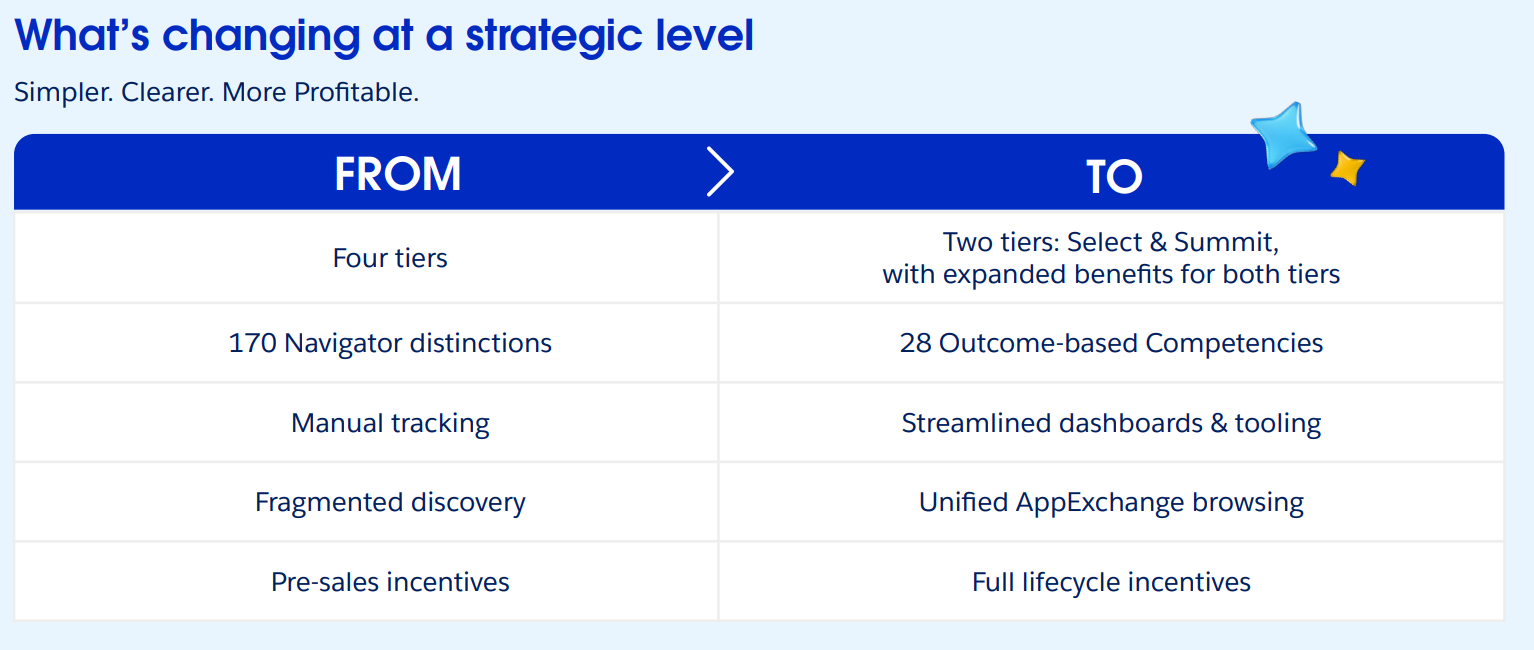
The FY27 Salesforce Consulting Partner Program introduces a simplified structure with just two primary partner program tiers: Select and Summit. At the same time, Salesforce is retiring Navigator distinctions and replacing them with competency-based recognition that measures certifications, completed projects, and customer satisfaction. The objective is to help customers identify Salesforce partner companies with proven expertise while giving partners clearer paths to differentiation and growth.
Beyond tiering changes, FY27 also introduces new discovery mechanisms through AgentExchange, expanded partner tooling, and a stronger focus on measurable business outcomes. Whether you are evaluating Salesforce partner program requirements, considering the Salesforce consulting partner program for the first time, or preparing your organization for FY27, understanding these changes is essential for maintaining visibility and competitiveness in the Salesforce ecosystem.
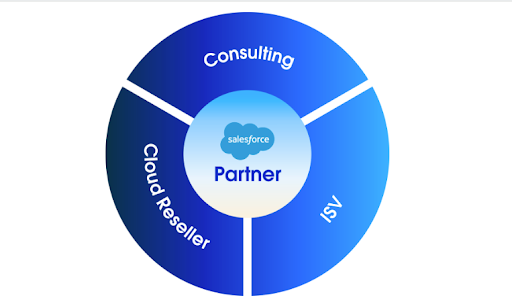
The biggest FY27 changes at a glance
For the full set of program details, please refer to the FY27 Consulting Partner Program Policies and the following resources:
- Program Overview: FY27 Consulting Track Brochure
- Detailed Overview: FY27 Consulting Track Overview
- Partner Community Learn Pages:
Salesforce consulting partners
The Salesforce Consulting Partner Program is designed for companies that help customers implement, customize, integrate, and optimize Salesforce products. Consulting partners provide a wide range of services, from CRM strategy and digital transformation consulting to complex Salesforce development, managed services, data migration, and AI adoption initiatives.
FY27 marks a major shift in how Salesforce evaluates consulting partners. The program is now built around the concept of the Agentic Enterprise, where AI-powered systems and agents are embedded into business processes to drive measurable outcomes. As a result, Salesforce is placing less emphasis on program complexity and more emphasis on proven delivery, specialization, customer satisfaction, and business results.
For consulting partners, the benefits go beyond access to Salesforce training and enablement resources. Partners gain:
- Specialized product training and demo environments
- Joint go-to-market opportunities with Salesforce
- Visibility through AppExchange and AgentExchange
- Financial incentives tied to customer success and lifecycle impact
- Co-branding opportunities that help build credibility with prospects
- Access to partner tooling, dashboards, and enablement resources
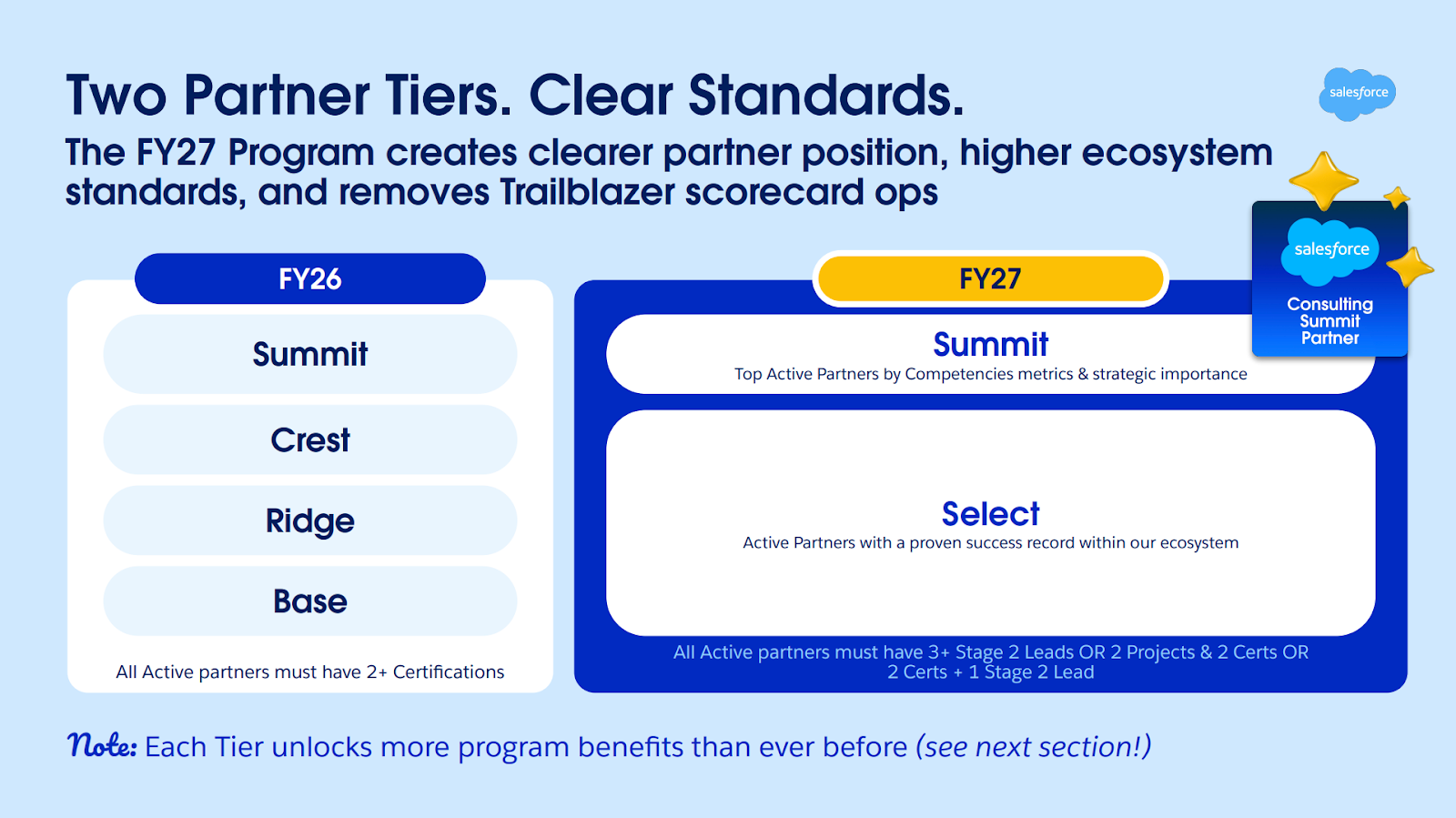
One of the biggest FY27 changes is the simplified partner structure. Salesforce has reduced four consulting partner tiers to just two: Select and Summit. Select partners demonstrate proven delivery capabilities and meet minimum program requirements, while Summit partners represent the highest-performing organizations based on competencies, certifications, customer success, project delivery, and strategic importance within the Salesforce ecosystem.
The program also replaces the long-standing Navigator framework with a new competency model. Instead of earning points across dozens of specializations, partners now earn competencies based on three measurable factors:
- Salesforce certifications
- Completed customer projects
- Customer satisfaction (CSAT) scores
These competencies are displayed on AgentExchange, helping customers identify partners with verified expertise in specific products and industries. Salesforce has reduced 170 Navigator distinctions to 28 competency areas, making it easier for customers to evaluate partner capabilities and for partners to demonstrate specialization.
For consulting partners, the overall direction is clear. Salesforce wants partners to focus on customer outcomes, industry expertise, Agentforce readiness, and long-term customer success. Organizations that can demonstrate these capabilities through certifications, project delivery, and strong CSAT performance will be better positioned to achieve higher competency levels, strengthen their visibility in the Salesforce partner ecosystem, and benefit from expanded financial incentives in FY27.
For the full set of program details, please refer to the FY27 Consulting Partner Program Policies.
To enroll in the Consulting Partner Program Track, click here.
Check out the FY27 Consulting Track Launch Deck.
Salesforce consulting partner tiers and competencies
One of the biggest changes in the FY27 Salesforce Consulting Partner Program is the move away from the previous Navigator framework toward a simpler competency-based model. Salesforce now evaluates partners based on demonstrated expertise, successful project delivery, and customer satisfaction rather than a complex points system.
Partner tiers
New consulting partners begin in the Provisional tier. Once they meet the minimum program requirements, they become eligible for advancement to the Select tier and gain access to additional program benefits.
To qualify as a Select partner, organizations must meet one of the following requirements:
- 2 Salesforce certifications and 1 qualified Stage 2 lead
- 3 qualified Stage 2 leads
- 2 Salesforce certifications and 2 qualified customer projects
Salesforce defines a qualified project as a completed engagement with a validated customer organization ID and an end date within the current or previous fiscal year. Detailed eligibility requirements and submission guidelines are available in Salesforce's Project Submissions documentation.
Above Select sits the Summit tier, reserved for Salesforce's highest-performing consulting partners. Summit status is based on factors such as earned competencies, completed projects, certifications, customer success, and strategic importance within the Salesforce ecosystem.
Definitions:
Certification Eligibility: The certification is accepted by the Partner Program and the status is in either "Active", "Current", or "Maintenance Due". All learners are counted towards the Partner Summary account linked in their Trailhead account. A full list of all Products and Sub-categories alignment can be found under the Certifications section of the Competencies Learn Page.
Stage 2 Lead Eligibility: The lead must be converted into Stage 2 Date in the current or previous fiscal year.
Qualified Project Eligibility: The project must have an End Date in the current or previous fiscal year and be in Completed status. The project must also have a validated Customer Org ID or non-core ID equivalent. For instructions on how to submit projects, please visit the Project Submissions Learn page.
Once a partner has met the Consulting Program minimum requirements, they are considered an active Consulting Partner and scheduled for a tier advancement to Select, which unlocks new Program Benefits.
Competencies replace Navigator
FY27 officially retires Navigator and replaces it with Competencies, a framework designed to help customers identify partners with proven expertise in specific Salesforce products and industries.
Competencies are measured using three factors:
- Salesforce certifications
- Completed customer projects
- Customer satisfaction (CSAT)
Unlike the previous system, competencies are directly aligned with Salesforce clouds and industry solutions, making it easier for customers to understand a partner's specialization.
Salesforce now offers two competency levels:
An Accredited Competency demonstrates foundational delivery capability and consistent customer outcomes. An Expert Competency reflects larger delivery capacity, deeper specialization, and a stronger track record of customer success.
Competency badges are displayed on AgentExchange, helping partners increase visibility and making it easier for prospective customers to find qualified Salesforce consulting partners.
Competencies Dashboard
To support the new framework, Salesforce introduced a redesigned Competencies Dashboard. The dashboard gives partners a real-time view of their tier status, competency progress, certifications, submitted projects, and CSAT performance.

Several improvements make the dashboard easier to use than previous reporting tools:
- Daily updates across all competency metrics
- Downloadable CSV and XLSX reports
- Filters for certifications and eligible projects
- Visibility into competency expiration dates
- Progress tracking toward Accredited and Expert status

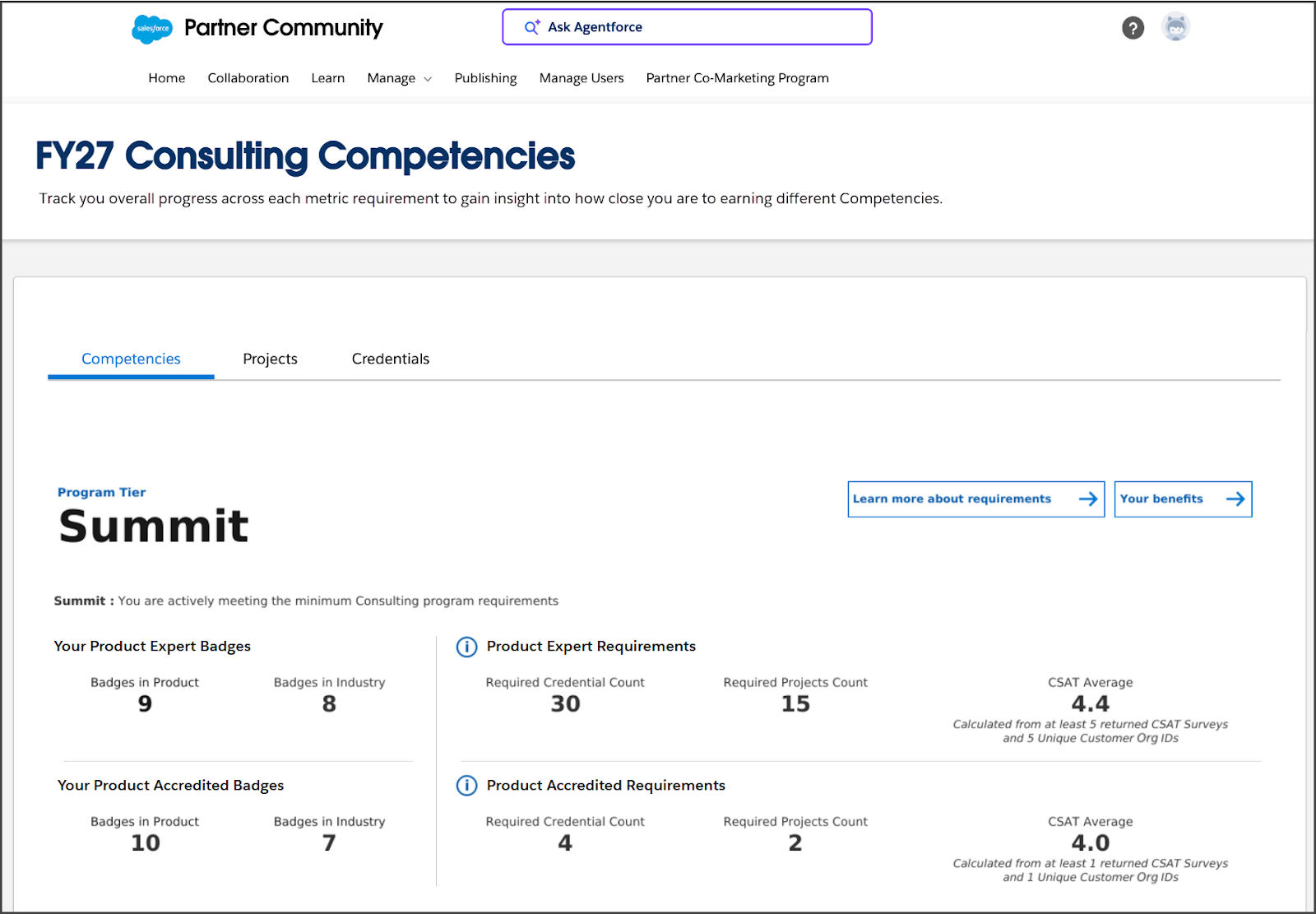
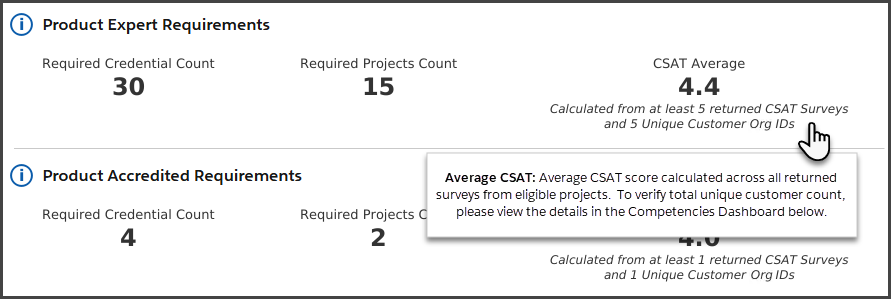
A helpful reminder of the Expert and Accredited Requirements of each badge is also listed for easy reference. You can hover over each requirement for further information.
Salesforce also uses color-coded indicators to show competency health:
- Green: all requirements are currently met
- Yellow: competency was earned previously but some requirements are no longer being maintained
- Grey: requirements are not currently met.
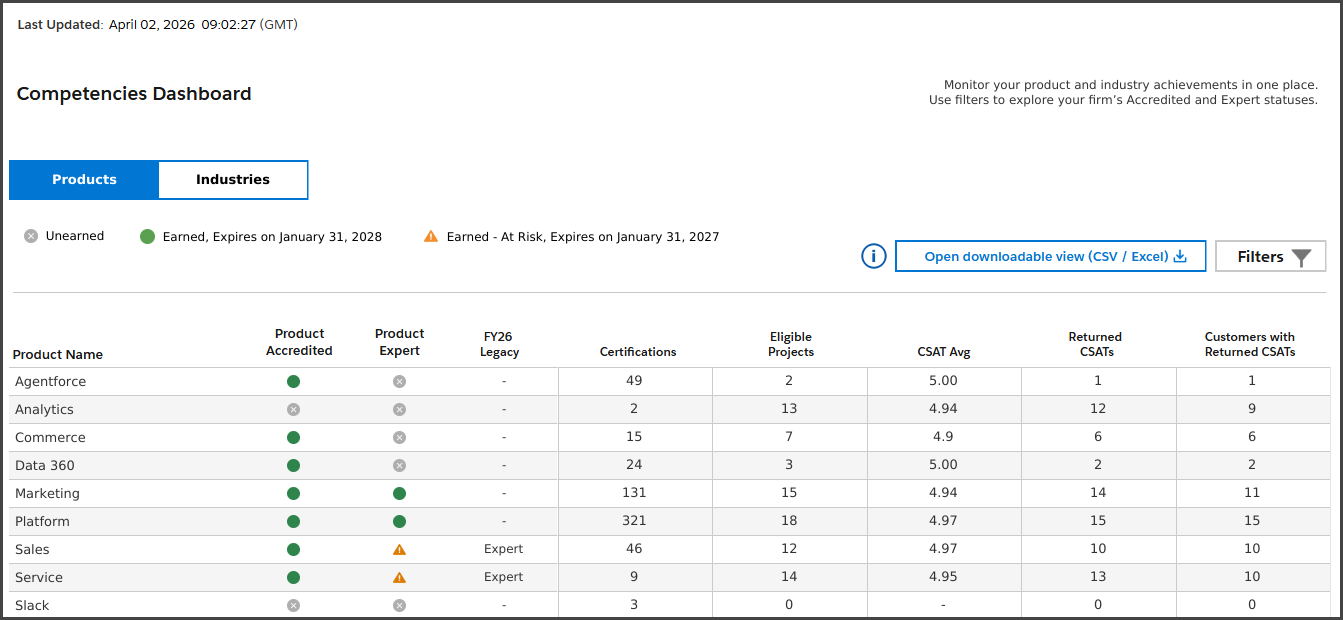
To view a full list of FY27 Product Competencies and their sub-category alignment, visit the Project Submissions learn article.
Salesforce Consulting Partner project and certification tracking
The new dashboard includes dedicated sections for project management and credential tracking.
The Projects view displays all eligible completed projects, including project dates, customer organization IDs, CSAT scores, submitted products, and competency alignment. Partners can also review CSAT distribution across projects and identify areas where customer satisfaction can be improved.
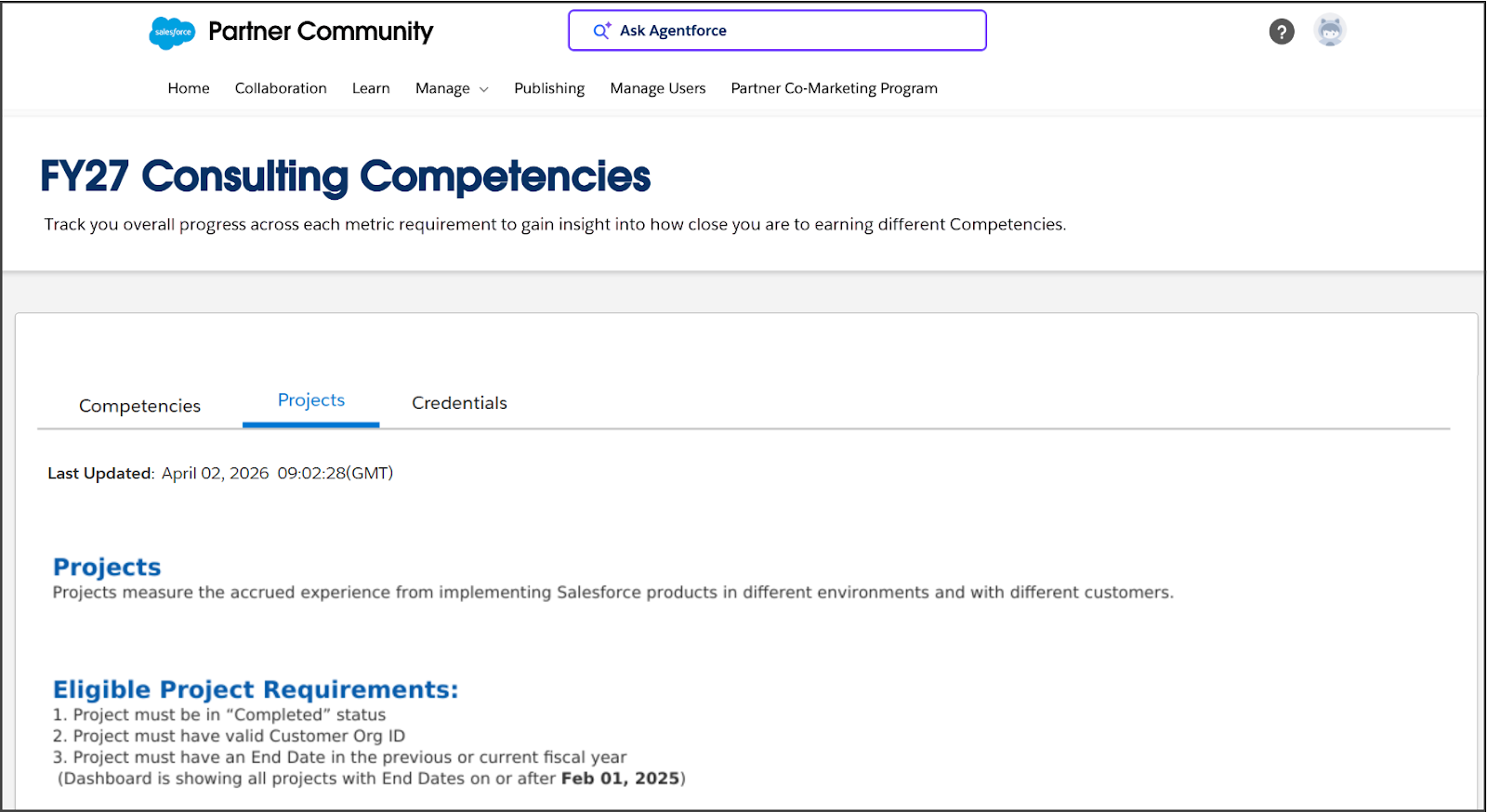
You can hover over each summary total for further information.
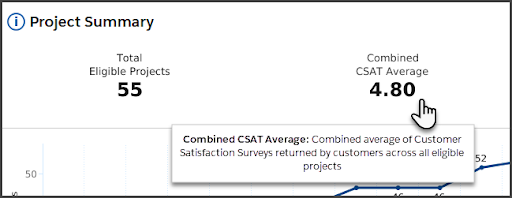
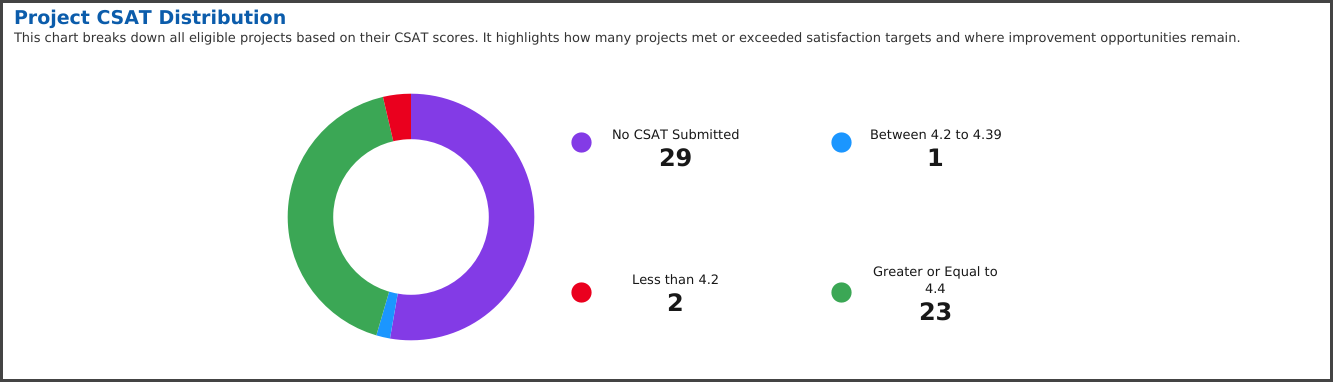
Next you will find a summary of Project CSAT Distribution. This chart breaks down all eligible projects based on their CSAT scores. It highlights how many projects met or exceeded satisfaction targets and where improvement opportunities remain.
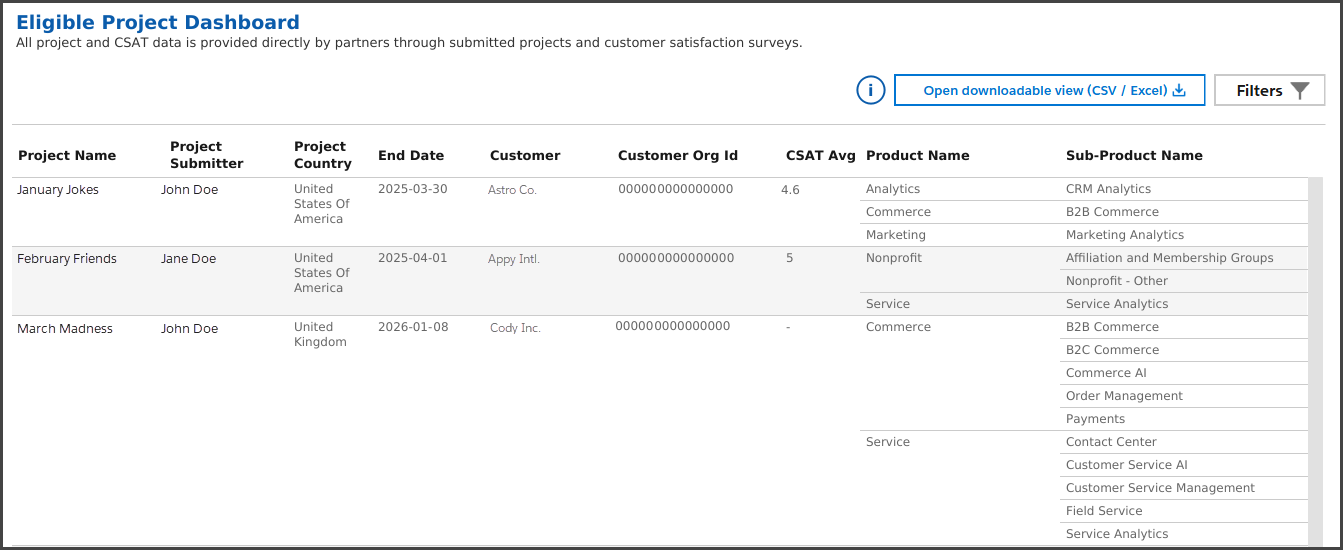
The lower part of the page contains the Eligible Project Dashboard. Here you will find all eligible projects listed out along with helpful information such as who submitted the projects, the end date, customer Org Id, CSAT Average, and Products and Subproducts selected during project submission. There are additional filters to refine your view and if you wish to download the list of projects, you can do so in either a CSV or XLSX document.
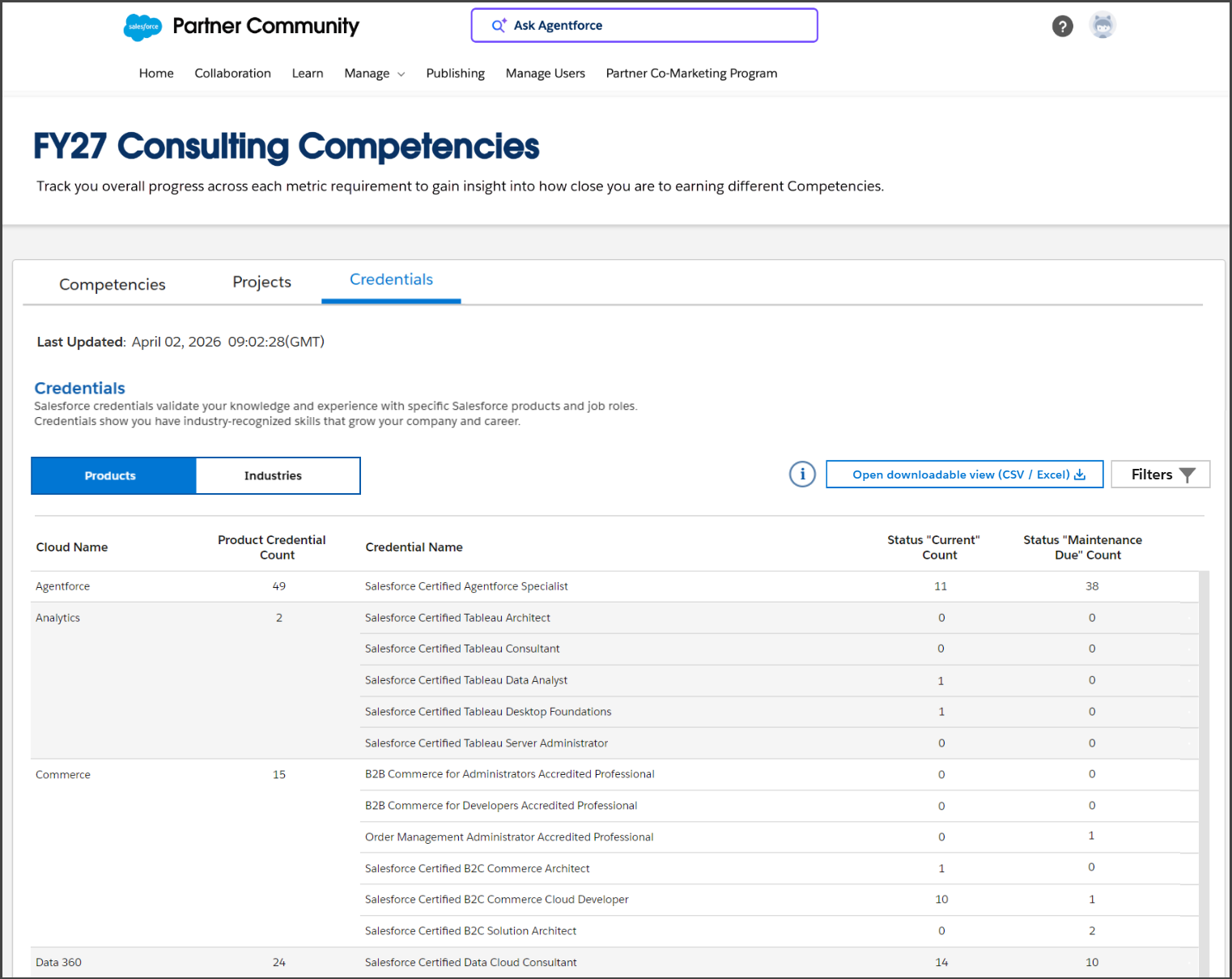
The Credentials view tracks certification progress by competency area. Only certifications aligned with the relevant Salesforce product or industry competency count toward qualification requirements. Salesforce provides a complete certification-to-competency mapping through its official Competencies documentation.
Together, these updates make it easier for partners to understand where they stand, identify gaps, and build a clear path toward higher competency levels and Summit status.
How to submit projects in the Salesforce Partner Program
Project submissions play a central role in the FY27 competency framework. Salesforce uses submitted projects, together with certifications and customer satisfaction scores, to evaluate partner expertise and determine competency eligibility.
Partners can submit projects directly from the Projects section of the Salesforce Partner Community. Salesforce offers two submission methods depending on the volume of projects that need to be registered.
Option 1: Individual project submission
The standard submission process allows partners to register customer projects one at a time through an online form.
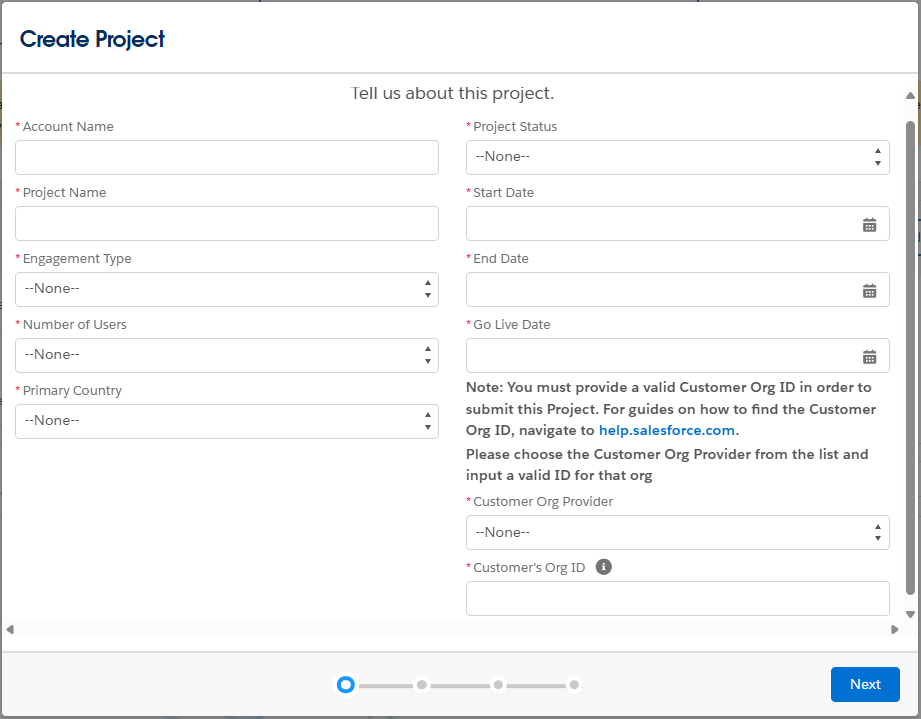
After a project is submitted and marked as Completed, Salesforce automatically sends a CSAT survey to the designated customer contact. The resulting customer satisfaction score becomes part of the competency evaluation process and contributes to overall partner performance metrics.
This approach works well for partners that submit projects regularly and want greater control over individual project records.
Option 2: Bulk project upload
New in FY27, Salesforce introduced a Bulk Project Upload capability that allows partners to submit multiple projects simultaneously using a standardized spreadsheet template.
The feature is particularly useful for:
- Registering historical projects
- Uploading large volumes of completed work
- Reducing manual data entry
- Ensuring submissions meet Salesforce validation requirements
Once uploaded, eligible projects follow the same review process as individually submitted records. Projects marked as Completed automatically trigger CSAT surveys unless the partner chooses to opt out for a specific project.
For organizations with extensive delivery portfolios, the bulk upload option can significantly reduce administrative effort while helping maintain accurate competency reporting.
Salesforce provides detailed instructions, templates, and validation requirements through its Project Bulk Upload Template Instructions guide and the Partner Community documentation.
What Salesforce consulting partners should prioritize in FY27
The FY27 Salesforce Partner Program rewards demonstrated expertise, customer success, and measurable business outcomes. Partners that adapt early to the new competency model will be better positioned to increase visibility, qualify for higher tiers, and participate in more joint go-to-market opportunities.
Key priorities for FY27 include:
- Earning new Salesforce competencies aligned with strategic products and industries
- Strengthening your AgentExchange and AppExchange presence to improve discoverability
- Taking advantage of lifecycle-based financial incentives and joint GTM initiatives
- Increasing certification coverage in target competency areas
- Submitting completed projects and collecting CSAT feedback consistently
Salesforce has also introduced several operational improvements designed to reduce administrative work and help partners move faster. These include:
- Real-time competency and performance dashboards
- Bulk project upload capabilities
- Expanded access to demo environments, Partner Developer Editions, and internal-use benefits
- Simplified tier qualification requirements
- Improved reporting and competency tracking tools
Taken together, these changes make the Salesforce Consulting Partner Program more outcome-focused, easier to navigate, and more closely aligned with customer success. Partners that invest in competencies, certifications, project submissions, and customer satisfaction will have the strongest foundation for growth in the Agentforce era.
Salesforce partner program benefits and financial incentives
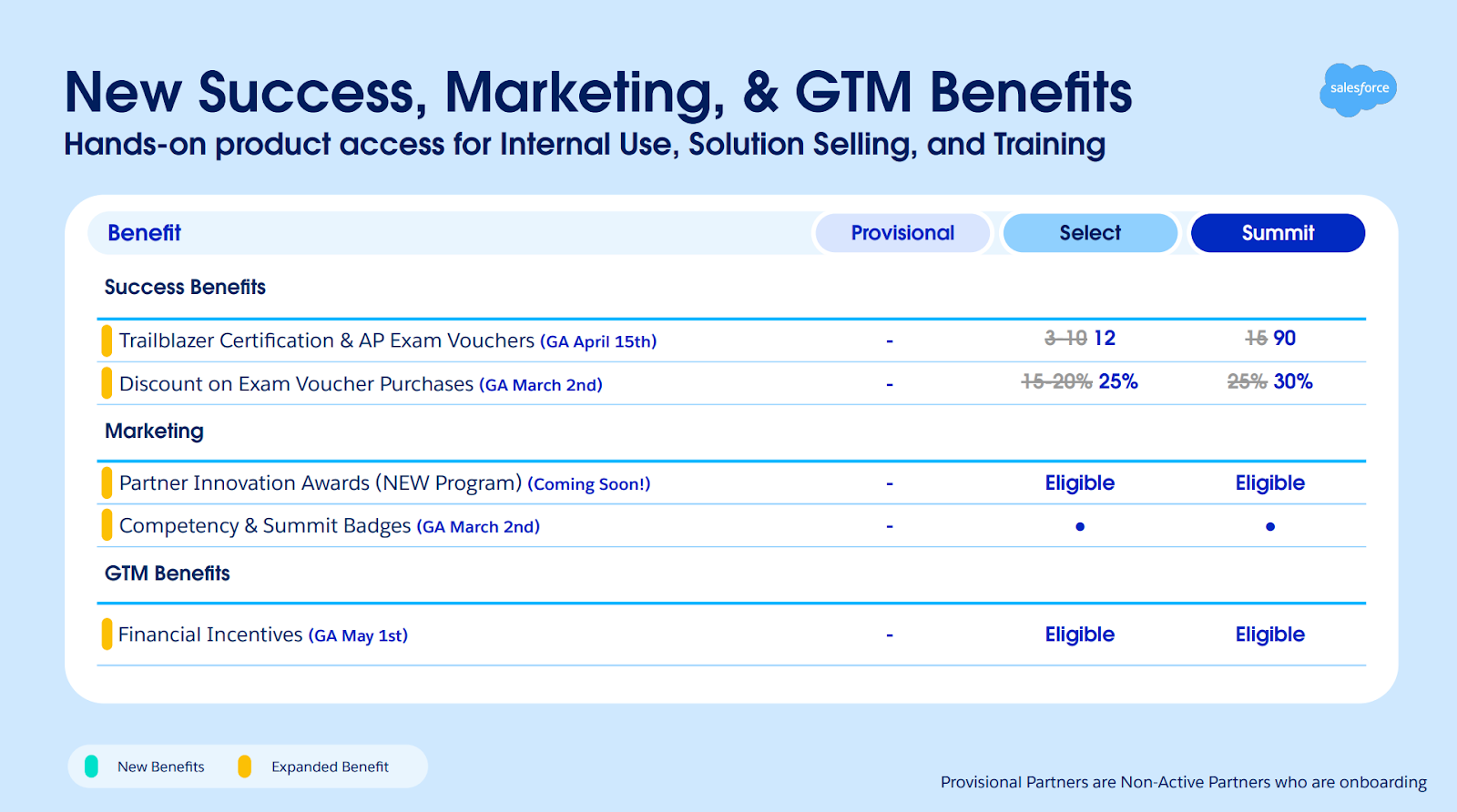
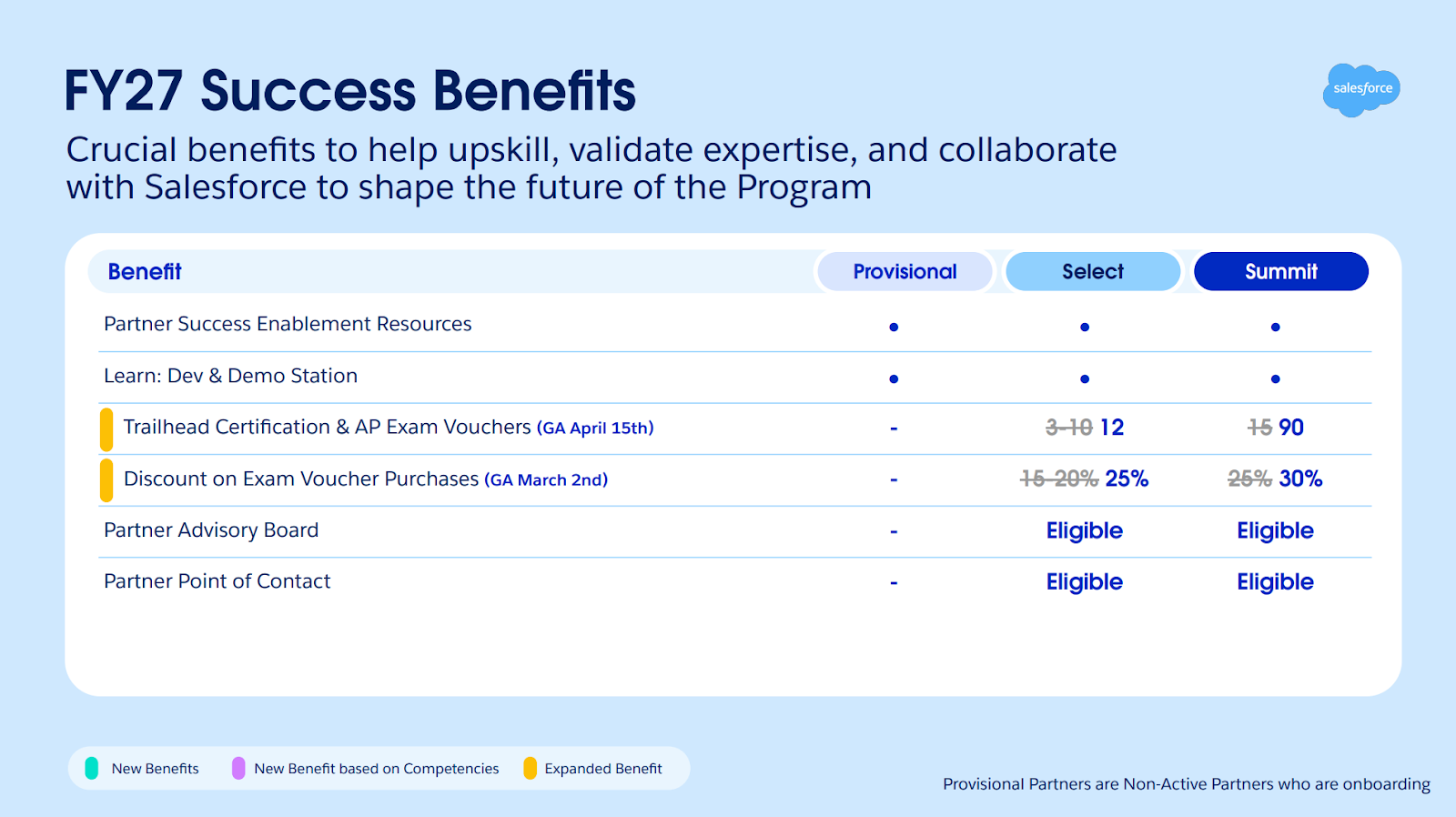
The FY27 Salesforce Consulting Partner Program is designed not only to recognize partner expertise but also to support partner growth through a combination of product benefits, enablement resources, and financial incentives.
Program benefits
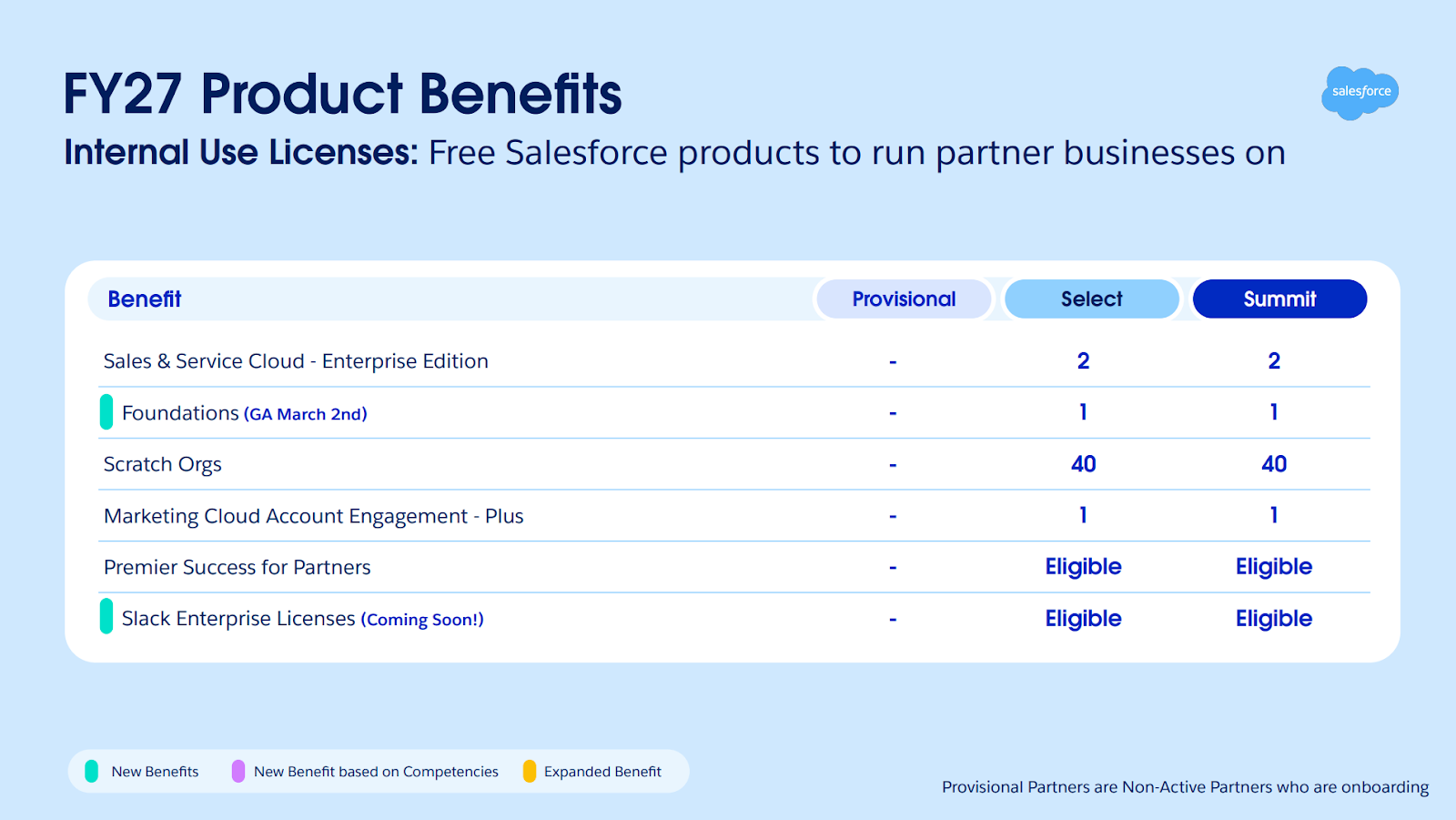
Salesforce provides consulting partners with access to resources that help accelerate delivery, strengthen technical capabilities, and support business development efforts. Available benefits vary by partner tier, but may include:
- Product training and enablement resources
- Demo environments and Partner Developer Editions
- Internal-use licenses
- Certification vouchers
- Joint branding opportunities
- Marketing and co-selling support
- Enhanced access to Salesforce tools and partner resources
Salesforce has also expanded several benefits in FY27, particularly for Select and Summit partners, reflecting the increased focus on competencies and customer success.
Visit the Program Benefits page to see what’s available at your tier.
Financial incentives
Salesforce is increasing its investment in partner-led growth through expanded financial incentive programs. The company views consulting partners as a key driver of customer adoption, product consumption, and long-term success.
FY27 incentive programs are designed to reward partners for:
- Sourcing new opportunities
- Participating in joint sales activities
- Driving customer adoption and consumption
- Delivering successful customer outcomes
- Supporting long-term account growth
The shift aligns with Salesforce's broader focus on the Agentic Enterprise, where customer value is measured not only by implementation success but also by ongoing business impact.
Rather than focusing solely on initial sales activities, FY27 places greater emphasis on lifecycle engagement. Partners that continue to support customers after implementation through optimization, expansion, and managed services can benefit from stronger alignment with Salesforce's growth objectives.
Visit the Financial Incentives page to learn about current offerings and eligibility.
Additional resources for consulting partners
Salesforce also provides a range of resources to help partners stay informed and engaged throughout the fiscal year. These include:
- Partner branding guidelines
- Partner Community updates and communications
- Enablement materials and technical documentation
- Consulting Partner Program collaboration groups
- Program policy updates and release announcements
Partners should regularly review available resources and benefit updates, as Salesforce continues to evolve the program alongside its Agentforce and AI strategy.
Salesforce Cloud Reseller Partner Program
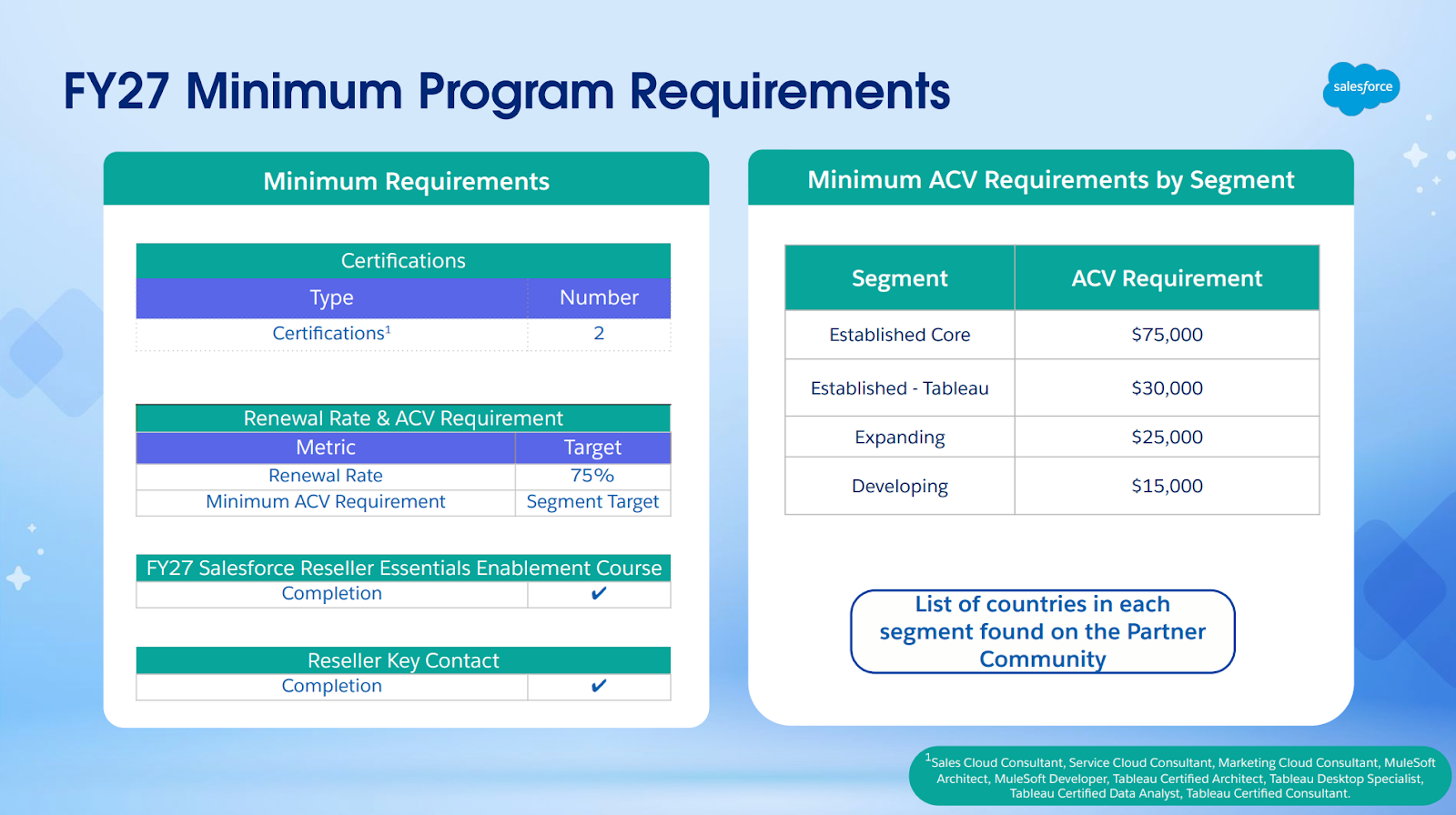
The Salesforce Cloud Reseller Partner Program is designed for organizations that resell and distribute Salesforce products. Unlike consulting partners, whose primary focus is implementation and services, cloud resellers are responsible for driving product sales, expanding Salesforce's market presence, and supporting customer acquisition across their regions.
Currently, the Salesforce reseller partner program is available in EMEA, Japan, APAC, and LATAM. The program is built around a transparent performance model that rewards partners for sales success, customer growth, and long-term engagement with Salesforce.
For the full set of program details, please refer to the FY27 Cloud Reseller Partner Program Policies. See also the following slide deck and Partner Community Pages:
- Program Overview: FY27 Cloud Reseller Track Overview Deck
- Partner Community Learn Pages:
Cloud Reseller partner tiers
The FY27 Cloud Reseller Program uses a three-tier structure:
- Base
- Ridge
- Crest

Newly enrolled cloud resellers start in the Base tier and are evaluated based on their performance throughout the program year. A partner's tier determines the benefits, incentives, and resources they can access.
Unlike the Consulting Partner Program, which focuses on competencies and customer delivery, reseller tiering is primarily driven by commercial performance. Salesforce reviews reseller performance at designated intervals during the year and assigns tiers accordingly.
Partners retain their assigned tier for the duration of the program year unless they are upgraded during the mid-year review period or impacted by compliance-related actions. The highest tier achieved during a program year becomes the partner's starting tier for the following year.
For more information, please see the FY27 Cloud Reseller Partner Program Policies.
Cloud Reseller Trailblazer Score
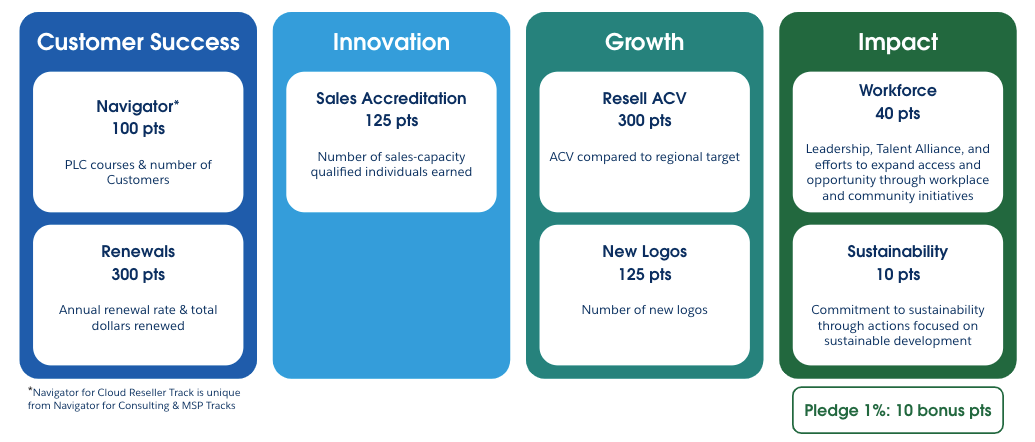
Salesforce evaluates reseller performance through the Cloud Reseller Trailblazer Score, which measures business performance against program requirements.
One of the most important factors is Annual Contract Value (ACV) performance. Salesforce reviews a reseller's trailing 12-month ACV contribution and uses that performance to determine eligibility for higher tiers and additional financial incentives.
Partners can monitor their performance through the Cloud Reseller Scorecard available in the Salesforce Partner Community. The scorecard provides visibility into performance metrics and helps partners understand where they stand relative to tier requirements.
Annual review cycle
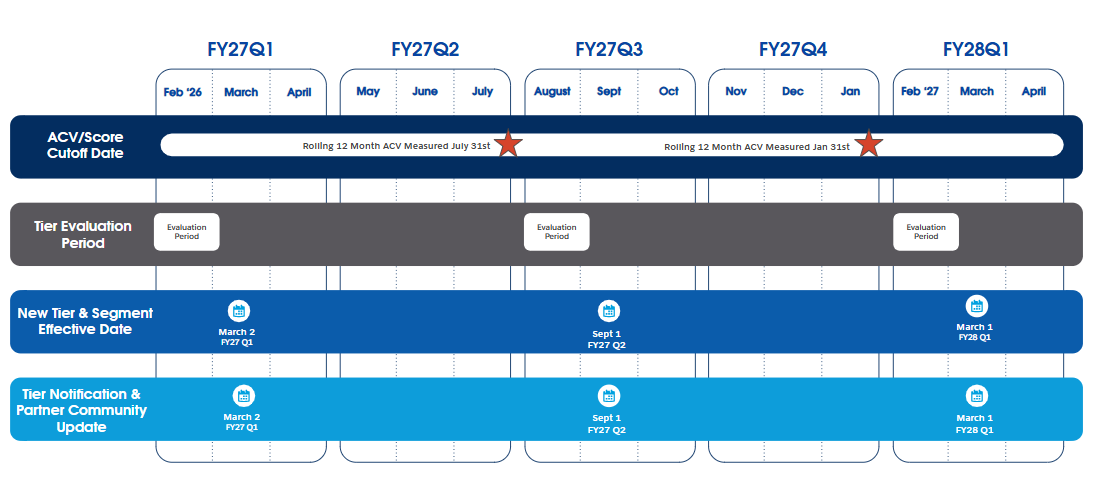
Cloud Reseller tier assignments are reviewed and communicated twice per year:
- March program review
- September program review
This review structure gives partners opportunities to improve their standing during the year while maintaining a predictable framework for benefits and incentive planning.
Cloud Reseller benefits
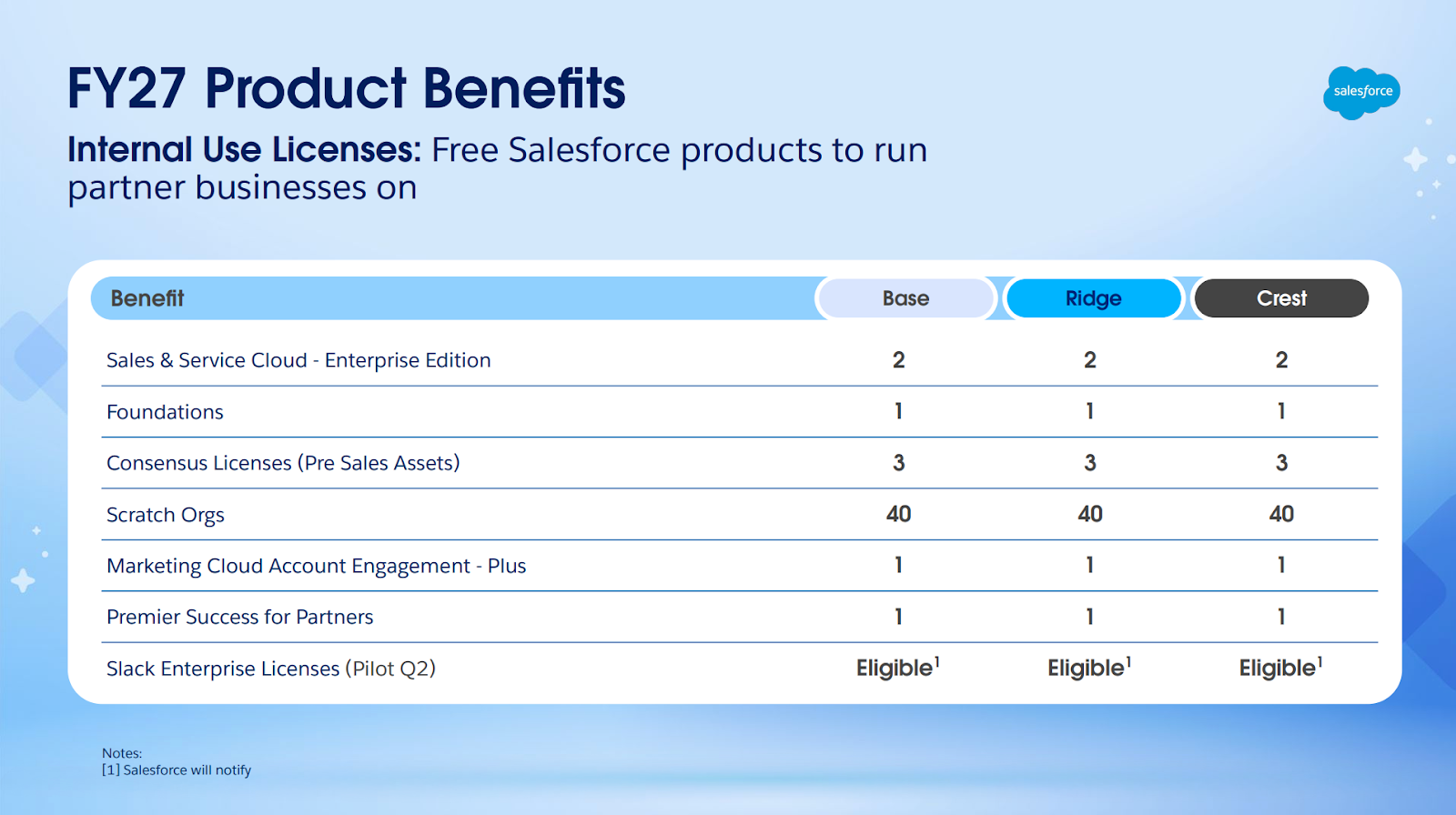
Salesforce groups Cloud Reseller benefits into two categories: non-financial benefits and financial incentives.
Non-financial benefits
Depending on tier level, partners may receive access to:
Product benefits
- Internal-use licenses
- Product access and demonstrations
- Solution-selling resources
- Training opportunities
Success benefits
- Enablement programs
- Certification and credential pathways
- Strategic guidance
- Partnership development opportunities
Marketing benefits
- Co-branding opportunities
- Demand generation resources
- Marketing support programs
- Sales enablement materials
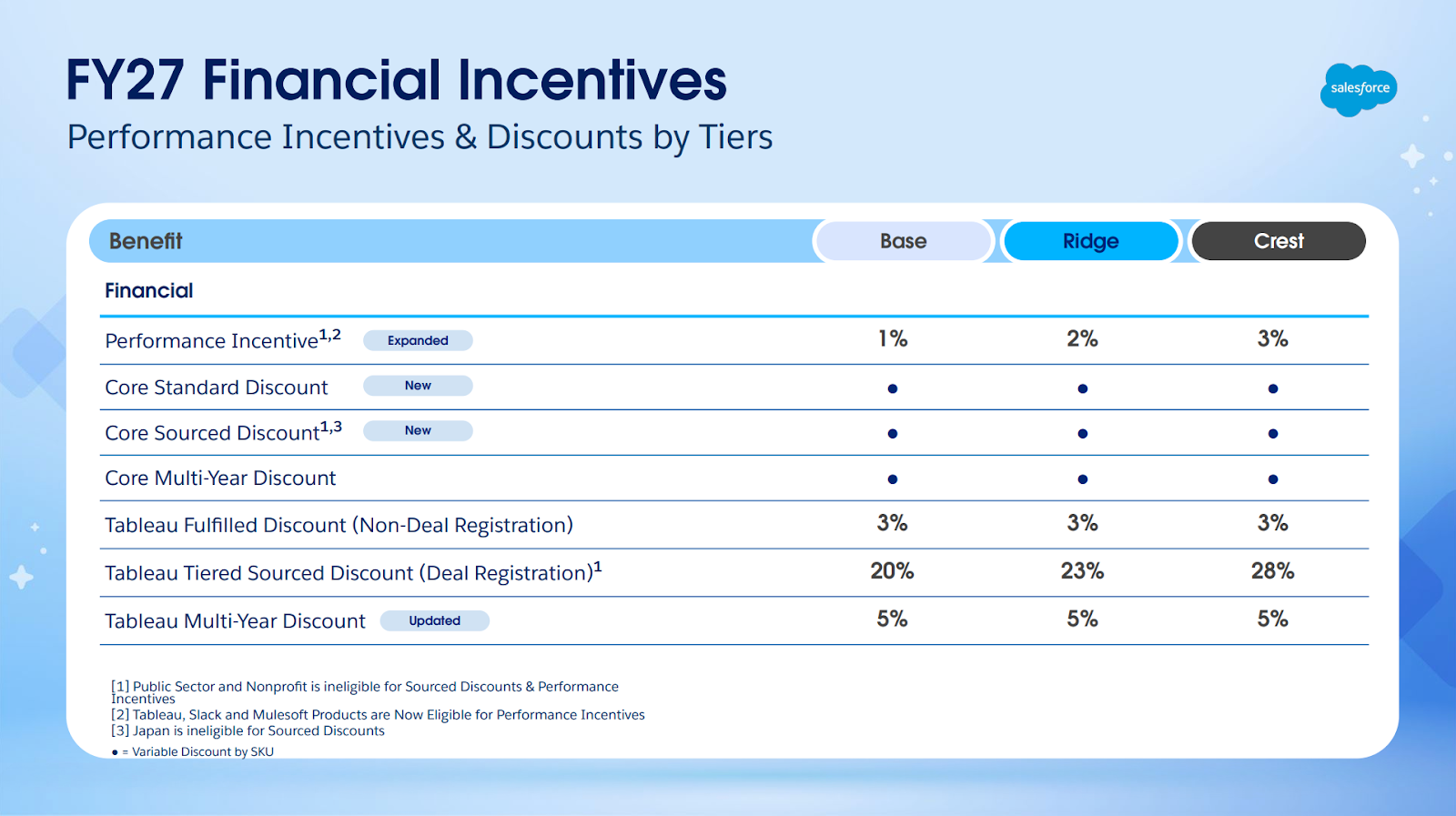
Financial incentives
Salesforce uses financial incentives to encourage activities that contribute directly to ecosystem growth, including:
- New customer acquisition
- Revenue growth
- Customer retention
- Market expansion
- Strategic product sales
Partners that consistently generate ACV and contribute to Salesforce growth can unlock additional rewards through the reseller incentive framework.
Visit the Cloud Reseller Benefits page to see what’s available at your tier.
Resources and enablement
Cloud Reseller partners also receive access to Salesforce enablement resources designed to support ongoing growth and engagement. These include:
- Partner branding guidelines
- Partner Community resources
- Program communications and updates
- Collaboration groups and networking opportunities
- Training and enablement content
For organizations focused on Salesforce sales and distribution, the Cloud Reseller Partner Program provides a structured path to grow revenue, strengthen relationships with Salesforce, and gain access to increasingly valuable benefits as performance improves.
Salesforce ISV Partner Program
The Salesforce ISV Partner Program is designed for software companies that build, distribute, and monetize applications on the Salesforce platform. ISV partners can either create standalone applications that extend Salesforce functionality or embed Salesforce technology into industry-specific solutions.
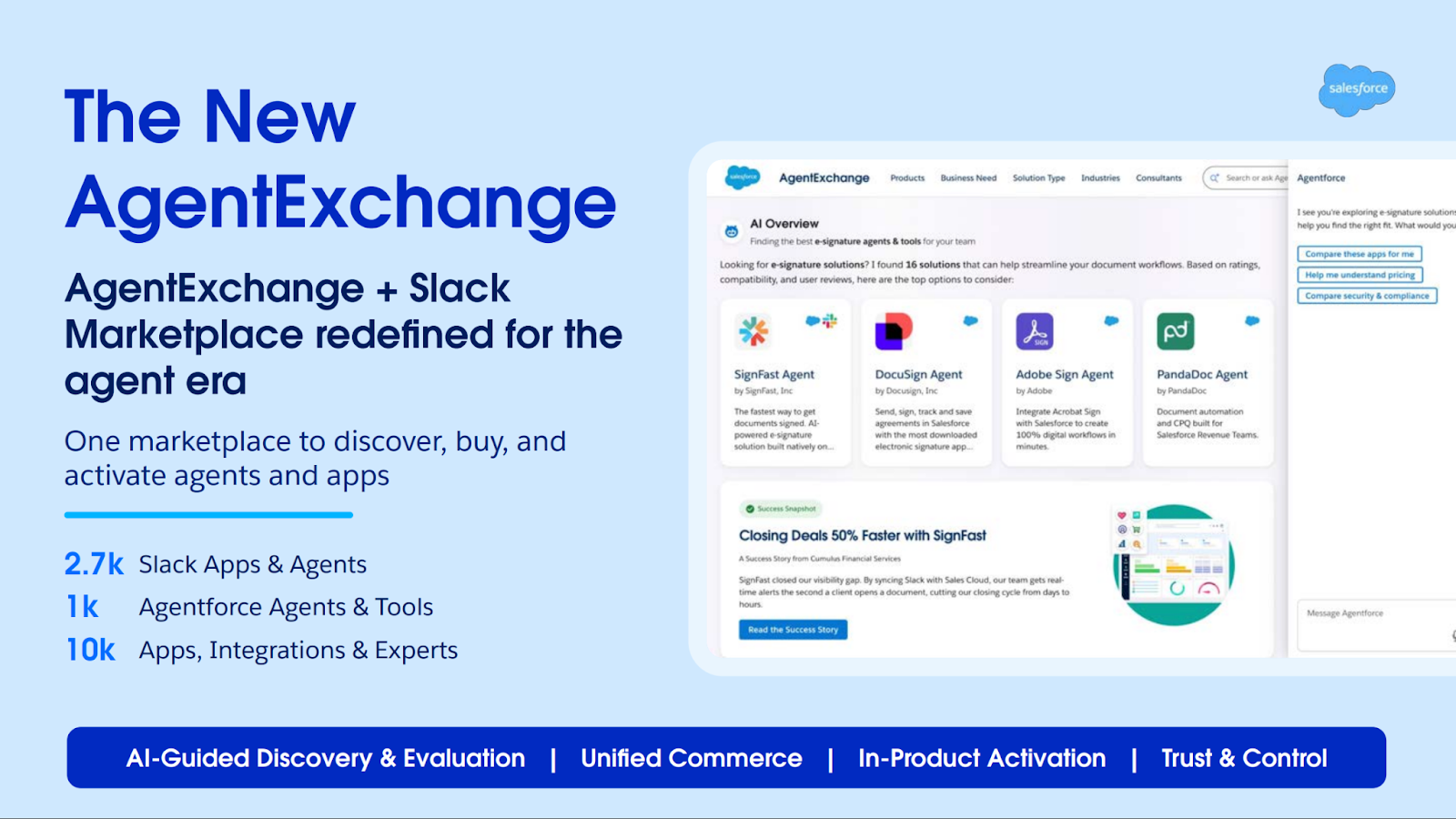
With Salesforce placing a strong emphasis on AI and Agentforce, the ISV track is increasingly focused on helping partners develop innovative applications that solve real business problems while reaching a global customer base through AppExchange and AgentExchange.
For the full set of program details, please refer to the AppExchange ISV Overview deck and Program Policies.
Are you a new partner? As a suggested first step we recommend checking out the AppExchange ISV Onboarding Guide.
Are you looking for technical guidance on how to build and distribute your app? Check out the ISVforce Guide.
What is a Salesforce ISV partner?
A Salesforce Independent Software Vendor (ISV) builds commercial applications, integrations, or industry solutions that run on Salesforce technology.
ISV partners benefit from:
- Access to Salesforce development tools and platform capabilities
- Distribution through AppExchange and AgentExchange
- Technical guidance and enablement resources
- Security review and compliance support
- Joint marketing and go-to-market opportunities
- Access to Salesforce's global customer ecosystem
The program is structured around the ISV partner journey, helping organizations move from product concept to commercial scale.
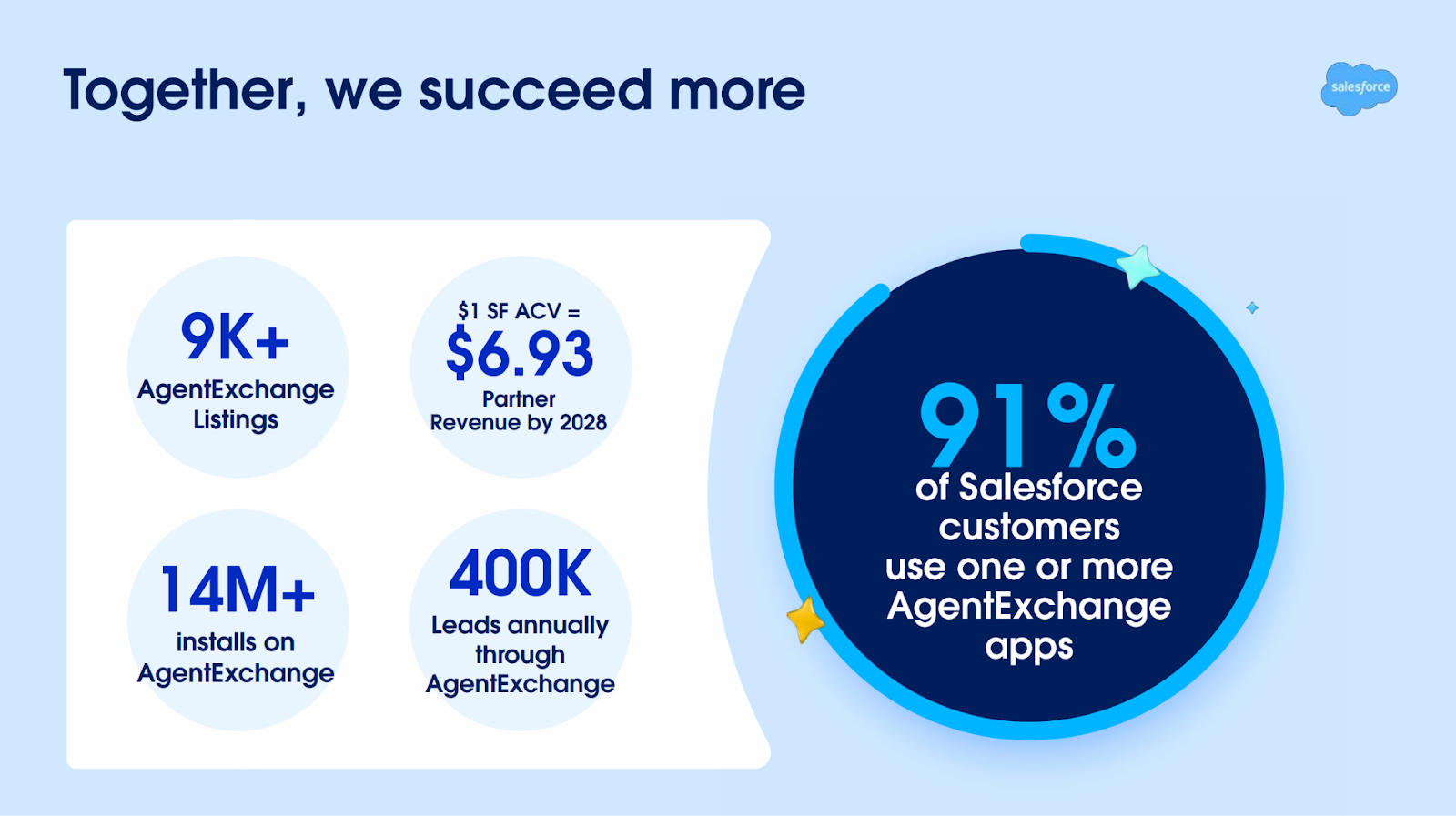
Salesforce ISV partner tiers
Unlike the Consulting Partner Program, which uses Select and Summit tiers, the ISV program follows a maturity-based journey model.
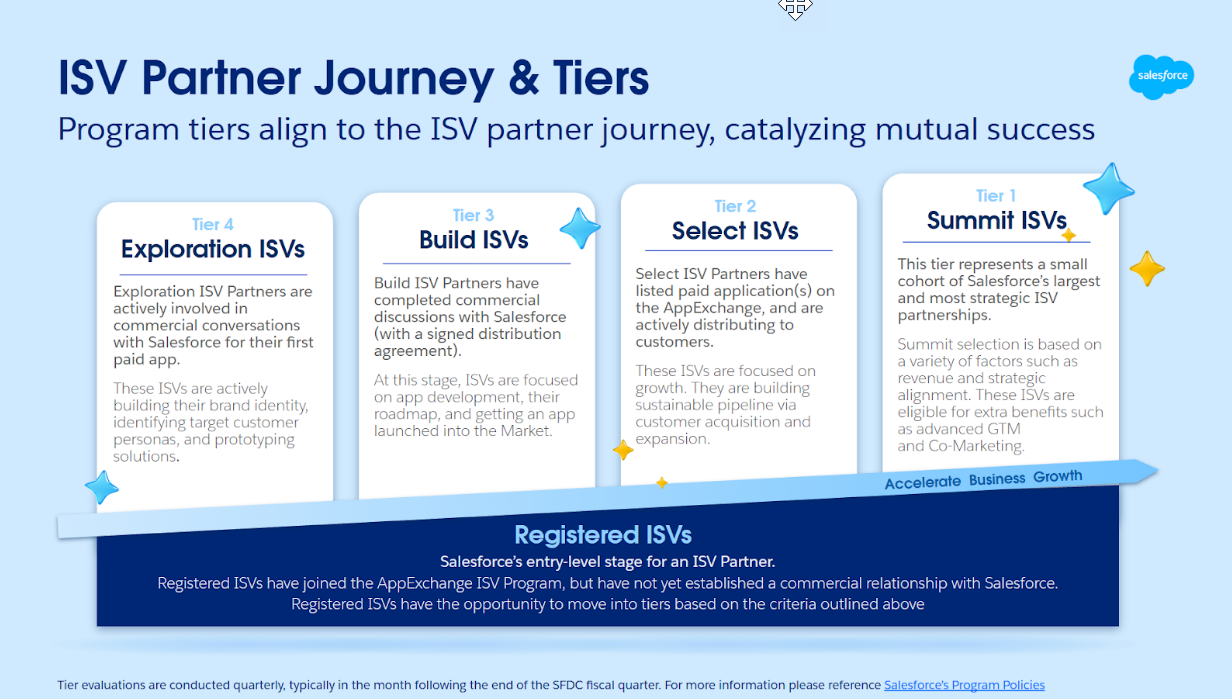
Registered ISV
The entry point for organizations joining the AppExchange ISV Program.
Registered ISVs have enrolled in the program but have not yet established a commercial relationship with Salesforce.
Tier 4: Exploration ISV
Exploration partners are typically working toward their first commercial product.
At this stage, organizations focus on:
- Defining target customer personas
- Building brand positioning
- Validating product concepts
- Preparing for commercial launch
Tier 3: Build ISV
Build partners have completed commercial discussions with Salesforce and signed the required distribution agreements.
The primary focus is:
- Product development
- Application roadmap execution
- AppExchange readiness
- Initial product launch
Tier 2: Select ISV
Select partners have launched paid applications on AppExchange and are actively acquiring customers.
Priorities at this stage include:
- Pipeline generation
- Customer acquisition
- Product adoption
- Revenue growth
- Market expansion
Tier 1: Summit ISV
Summit represents Salesforce's most strategic ISV relationships.
Selection is based on factors such as:
- Revenue performance
- Strategic alignment
- Market impact
- Business growth
Summit ISVs may receive additional co-marketing and go-to-market support from Salesforce.
A partner can access their scorecard via the Manage tab in the Partner Community.
How ISV tiers are evaluated
Salesforce evaluates ISV partners quarterly. Tier assignments are visible through the Partner Community scorecard and are reviewed following each Salesforce fiscal quarter.
This model allows partners to progress through the program as they move from product development to commercial growth and market leadership.
ISV program benefits

Salesforce organizes ISV benefits into five key categories that support product development, commercialization, and growth.
Business and sales
Resources designed to support revenue growth, customer acquisition, and stronger collaboration with Salesforce sales teams.
Marketing and lead generation
Programs and tools that help ISVs increase brand awareness, generate demand, and attract qualified leads.
Technical advisory
Access to Salesforce experts who can provide guidance on application architecture, development, security reviews, and product roadmaps.
Product and tools
Development environments, testing resources, analytics tools, and platform capabilities that help ISVs build and scale applications more efficiently.
Learning and enablement
Training programs, certifications, and educational resources designed to help partners expand their expertise and support customer success.
Additional resources for ISV partners
Salesforce provides a broad collection of resources to help ISVs successfully build and grow their products, including:
- AppExchange Partner Console
- Security Review resources
- Partner branding guidelines
- Press release guidelines
- Partner communications and updates
- Partnerblazer Slack Community
- Join the AppExchange ISV Partner Program Track collaboration group
- Join the AppExchange & ISV Technical Enablement collaboration group
- Alerts for Partners collaboration group
- Release Readiness for Partners collaboration group
- Check out the AgentExchange Partner Console guide
- New Technologies for Internal Use and OEMs.
For new partners, Salesforce recommends starting with the AppExchange ISV Onboarding Guide and the ISVforce Guide, which provide step-by-step guidance for building, publishing, and scaling applications within the Salesforce ecosystem.
Looking for a trusted Salesforce partner?
Understanding the Salesforce Partner Program is one thing. Choosing the right Salesforce partner for your business is another.
Noltic is a Salesforce Summit Consulting Partner with more than 160 Salesforce projects delivered across high-tech, financial services, manufacturing, nonprofit, healthcare, and professional services organizations. Our team includes 96 Salesforce-certified experts with more than 400 certifications covering Sales Cloud, Service Cloud, Revenue Cloud, Data Cloud, Marketing Cloud, Agentforce, Experience Cloud, Field Service, and MuleSoft.
Whether you need Salesforce implementation, managed services, AppExchange development, Agentforce adoption, or a long-term strategic consulting partner, our team can help you get measurable business results from your Salesforce investment.
Why companies choose Noltic
- Salesforce Summit Consulting Partner
- PDO Expert and Crest ISV Partner
- 140+ Salesforce projects delivered
- 96 certified Salesforce professionals
- 400+ Salesforce certifications
- ISO 27001:2022 certified
- Experience across consulting, implementation, integrations, AppExchange development, and managed services.
Frequently asked questions about the Salesforce Partner Program
What is the Salesforce Partner Program?
The Salesforce Partner Program is a framework that allows consulting firms, software vendors, and resellers to work with Salesforce as official partners. The program includes three primary tracks: the Salesforce Consulting Partner Program, the Salesforce ISV Partner Program, and the Salesforce Cloud Reseller Partner Program.
What is a Salesforce partner?
A Salesforce partner is an organization authorized to work within the Salesforce ecosystem. Depending on the partner type, they may provide implementation services, build AppExchange products, deliver managed services, develop integrations, or resell Salesforce products and licenses.
What is the Salesforce Consulting Partner Program?
The Salesforce Consulting Partner Program is designed for companies that provide Salesforce implementation, customization, integration, consulting, and managed services. In FY27, the program uses a competency-based model with Select and Summit partner tiers replacing the previous Navigator framework.
What are the Salesforce partner program tiers in FY27?
Partner tiers vary by program track:
- Consulting Partners: Provisional, Select, and Summit
- Cloud Reseller Partners: Base, Ridge, and Crest
- ISV Partners: Registered, Exploration, Build, Select, and Summit
Each tier provides different levels of benefits, visibility, enablement resources, and financial incentives.
What happened to Salesforce Navigator?
Salesforce Navigator has been replaced by Competencies. Instead of earning Navigator distinctions, partners now demonstrate expertise through certifications, completed projects, and customer satisfaction scores. Competencies are displayed on AgentExchange and help customers identify qualified Salesforce partner companies.
What are Salesforce competencies?
Salesforce competencies are specializations that validate a partner's expertise in specific products or industries. Competencies are measured using certifications, customer project delivery, and CSAT results. Partners can earn either Accredited or Expert competency status.
What is a Salesforce Summit Partner?
A Salesforce Summit Partner is the highest level of recognition within the Consulting Partner Program. Summit partners demonstrate strong delivery capabilities, extensive certifications, customer success, earned competencies, and strategic alignment with Salesforce.
What is the Salesforce ISV Partner Program?
The Salesforce ISV Partner Program helps software companies build, distribute, and monetize applications on Salesforce. Salesforce ISV partners can publish products on AppExchange and AgentExchange while gaining access to development tools, technical support, security review resources, and go-to-market programs.
What is the difference between a Salesforce ISV partner and a Salesforce consulting partner?
A Salesforce consulting partner helps customers implement and optimize Salesforce. A Salesforce ISV partner develops software products that run on Salesforce and are sold through AppExchange or AgentExchange. Some organizations participate in both programs.
What is the Salesforce Cloud Reseller Partner Program?
The Salesforce Cloud Reseller Partner Program is designed for organizations that resell Salesforce products and licenses. Partner performance is measured through the Cloud Reseller Trailblazer Score and Annual Contract Value (ACV), with partners assigned to Base, Ridge, or Crest tiers.
What are the Salesforce partner program requirements?
Requirements depend on the partner track. For consulting partners, Salesforce evaluates certifications, qualified projects, customer satisfaction scores, and Stage 2 leads. ISV partners are evaluated based on their stage of product development and commercial growth, while cloud resellers are assessed primarily on sales performance and ACV contribution.
How can I become a Salesforce partner?
Organizations can apply through the Salesforce Partner Community and choose the track that best matches their business model. Consulting firms typically join the Salesforce Consulting Partner Program, software vendors enter the Salesforce ISV Program, and resellers apply for the Salesforce Cloud Reseller Program.
What are the benefits of becoming a Salesforce partner?
Salesforce partner program benefits may include product training, certification vouchers, internal-use licenses, technical support, co-selling opportunities, marketing resources, AppExchange visibility, financial incentives, and access to Salesforce enablement programs. The exact benefits available depend on the partner track and tier.
.webp)

Navigating the Salesforce Partner Program in FY2026: benefits, requirements, and how to join
together