Agentforce for Financial Services: How AI agents are transforming banking, wealth management, and insurance

Artificial intelligence is rapidly changing how financial institutions serve customers, manage operations, and support employees. Yet many banks, insurers, and wealth management firms are discovering that generic AI tools often struggle with regulatory requirements, complex financial products, and the need for accurate customer context.
To address those challenges, Salesforce Agentforce for Financial Services introduces industry-specific AI agents built on Financial Services Cloud. Unlike traditional chatbots, these AI agents for financial services can understand customer data, follow predefined business processes, execute approved actions, and operate within compliance guardrails.
Salesforce Agentforce for Financial Services includes prebuilt capabilities for customer service, complaints management, self-service banking, relationship management, and voice interactions. Financial institutions can use AI agents in financial services to automate routine requests, support advisors and service teams, improve onboarding experiences, and deliver personalized customer interactions across channels.
In this guide, we'll explain what Agentforce for Financial Services is, explore its key capabilities, and examine how banks, wealth managers, asset managers, and insurers are using Salesforce Agentforce for Financial Services to improve efficiency while maintaining trust and regulatory compliance.
What is Agentforce for Financial Services?
Agentforce for Financial Services is Salesforce's industry-specific AI platform designed for banks, wealth managers, asset management firms, credit unions, and insurance providers. It combines autonomous AI agents, Financial Services Cloud, Data Cloud, and the Einstein Trust Layer to help financial institutions automate customer service, onboarding, relationship management, complaints handling, and other operational processes.
Unlike traditional AI assistants, Salesforce Agentforce for Financial Services can access customer data, follow business rules, execute approved actions, and transfer conversations to human employees when required. Agentforce 360 for Financial Services extends these capabilities by combining customer profiles, financial relationships, interactions, and operational data into a single view that AI agents can use to make informed decisions.
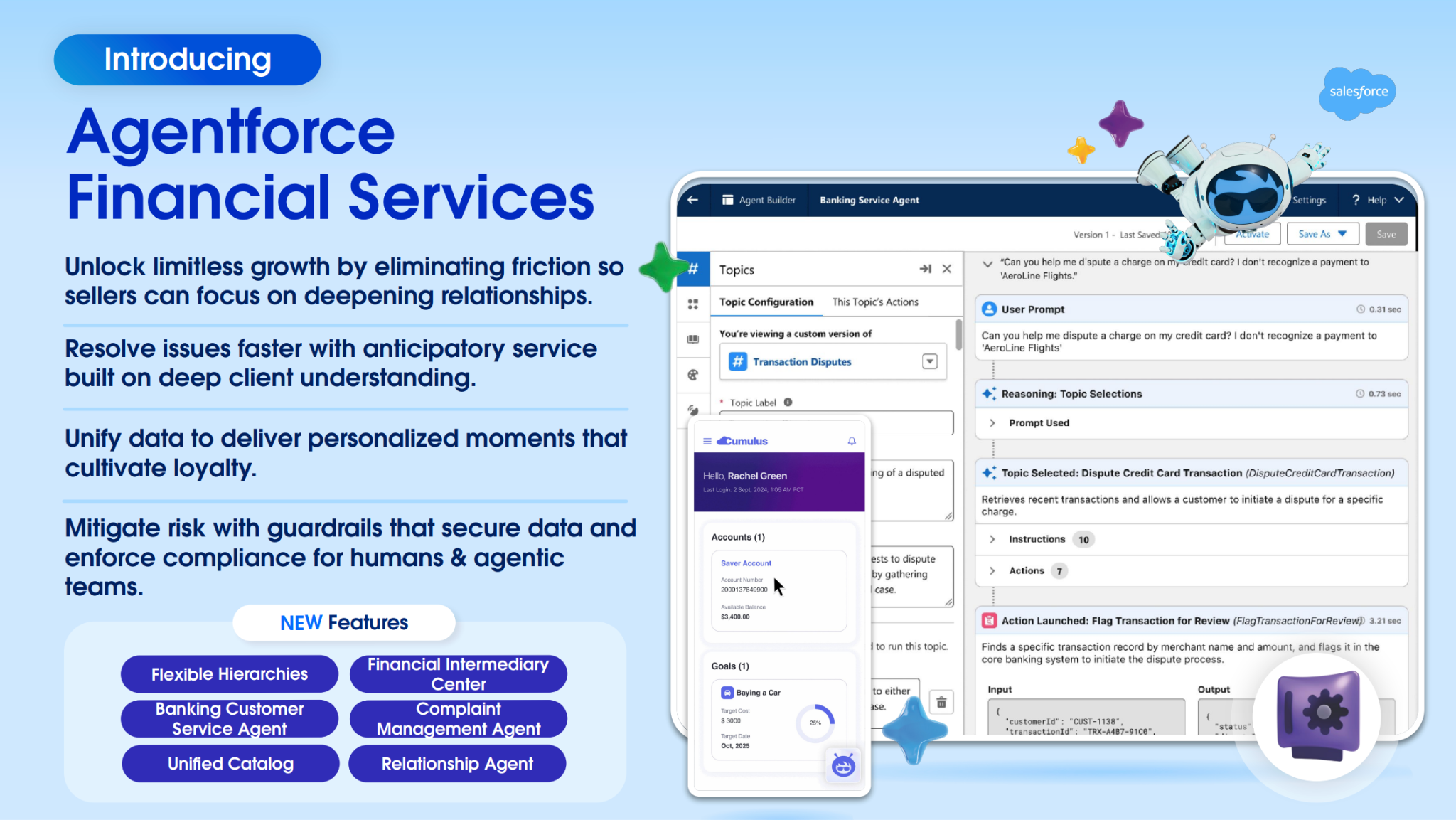
Agentforce vs Traditional financial services chatbots
Many financial institutions already use chatbots to answer basic questions. Agentforce takes a different approach.
Traditional chatbots are primarily conversational tools. They respond to predefined questions, provide information from knowledge bases, and often require customers to switch channels when a transaction or service request needs to be completed.
Agentforce uses autonomous AI agents that can understand customer intent, access relevant financial data, and initiate approved actions. Instead of simply explaining how to replace a lost card, an Agentforce Banking Customer Service Agent can authenticate the customer, initiate the replacement process, update records, and provide status updates throughout the interaction.
Another major difference is governance. Financial institutions operate in highly regulated environments where every interaction must follow compliance policies. Agentforce includes built-in guardrails, approval processes, and human handoff mechanisms that allow employees to take over when regulatory, risk, or business requirements demand human review.
How Agentforce 360 for Financial Services works
Agentforce 360 for Financial Services brings together several Salesforce technologies into a single AI-driven operating model.
Financial Services Cloud provides the industry-specific data model, including household relationships, financial accounts, policies, client profiles, referrals, and service processes.
Data Cloud unifies customer information from multiple systems, creating a real-time customer profile that combines transactional, behavioral, and operational data.
Agentforce delivers autonomous AI agents that can understand requests, reason through business processes, retrieve information, and perform approved actions.
Einstein Trust Layer provides security, compliance controls, auditability, and data governance to help institutions use AI responsibly.
The platform also connects with CRM records, core banking systems, policy administration platforms, claims systems, wealth management applications, and other external services. As a result, AI agents can work with the same information employees use while operating within established business rules.
Why financial institutions need industry-specific AI agents
Financial services organizations face challenges that generic AI tools are not designed to handle.
Regulatory requirements often dictate how customer information can be accessed, stored, and shared. AI systems must operate within strict compliance frameworks while maintaining complete records of every interaction.
Customer authentication is another critical requirement. Before executing financial transactions or sharing sensitive information, institutions must verify customer identities and enforce security controls.
Auditability also plays a central role. Banks, insurers, and wealth managers need detailed records showing what actions were taken, why they were taken, and which data sources were used during the process.
Sensitive financial data creates additional complexity. Generic AI models may generate inaccurate responses or expose information in ways that create operational or compliance risks. Industry-specific AI agents are designed around financial services workflows, approved business processes, and trusted data sources.
Top AI agents for financial services introduced by Salesforce
Salesforce Agentforce for Financial Services includes a growing portfolio of industry-specific AI agents designed to automate customer interactions, support employees, and execute financial services workflows. Unlike generic AI assistants, these agents are built around Financial Services Cloud data models, compliance requirements, and real-world banking, wealth management, and insurance processes.
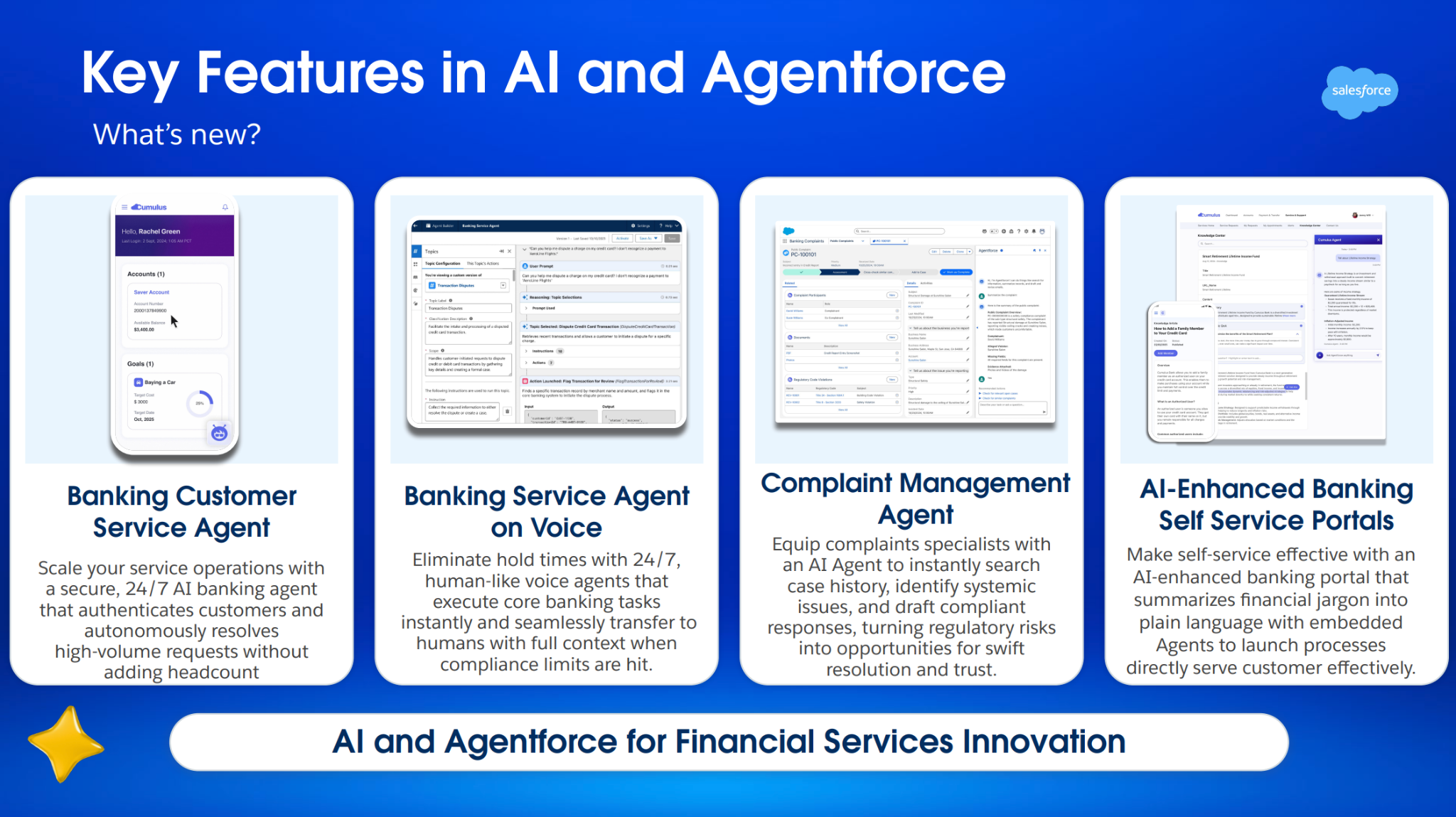
The table below highlights some of the most important AI agents for financial services currently available or announced by Salesforce.
Banking Customer Service Agent
Among the most practical AI agents financial services organizations can deploy today, the Banking Customer Service Agent is designed to handle high-volume service requests without increasing headcount. Customers can check balances, replace lost cards, dispute transactions, transfer funds, update account information, and complete other common requests through a single AI-powered interaction.
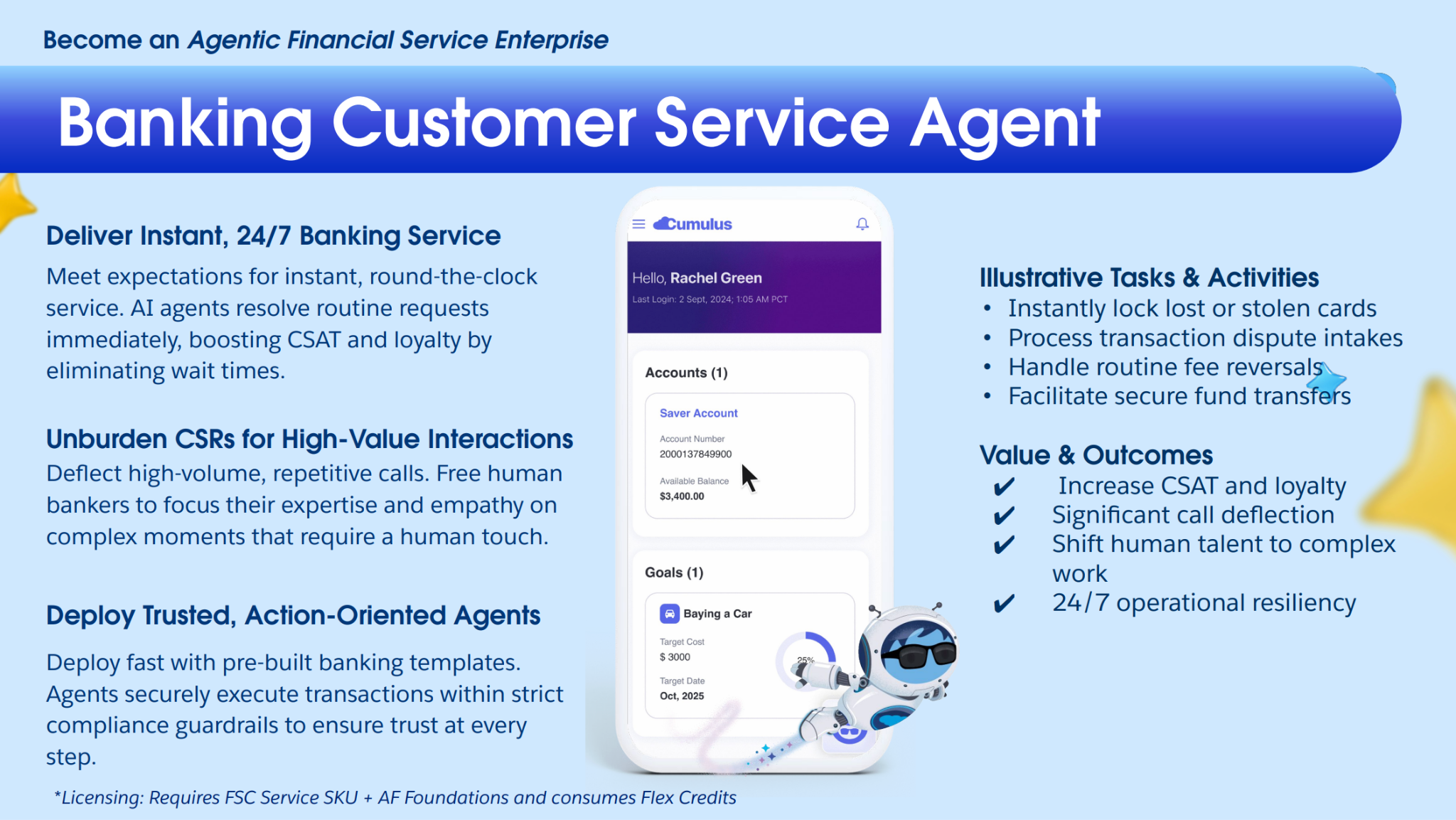
Because the agent can take action rather than simply answer questions, banks can reduce pressure on contact centers while maintaining a consistent customer experience.
Banking Service Agent on Voice
Voice remains one of the most important service channels in banking. The Banking Service Agent on Voice extends Agentforce capabilities into phone interactions, allowing customers to receive support at any time of day.
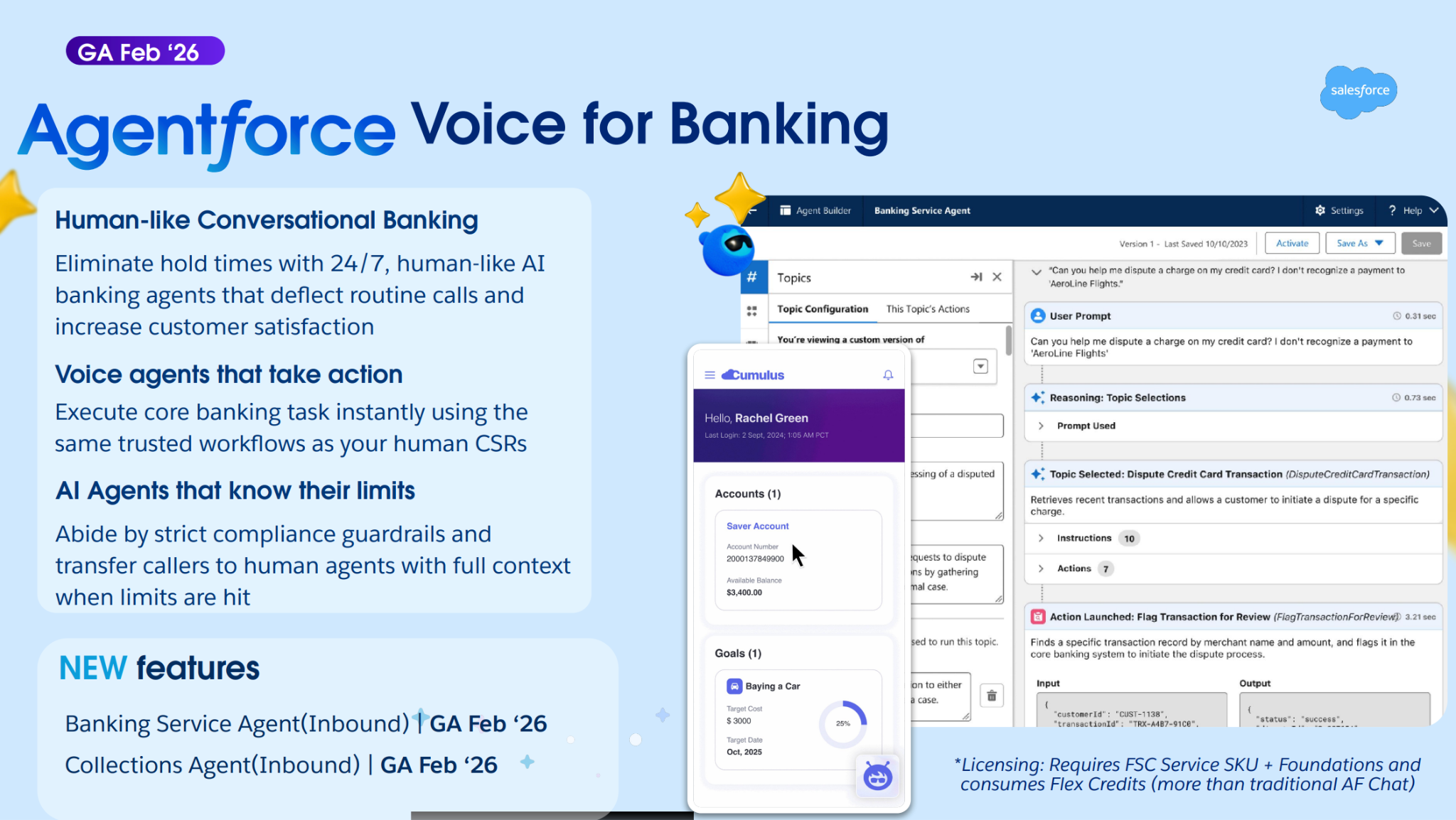
The agent can handle routine requests, execute approved banking workflows, and transfer calls to human employees when compliance rules or business policies require additional review. Financial institutions benefit from 24/7 service coverage while allowing service teams to focus on more complex conversations.
Complaint Management Agent
Complaint handling is often one of the most resource-intensive processes in regulated industries. The Complaint Management Agent helps service teams summarize complaints, identify similar cases, perform root-cause analysis, and generate compliant responses.
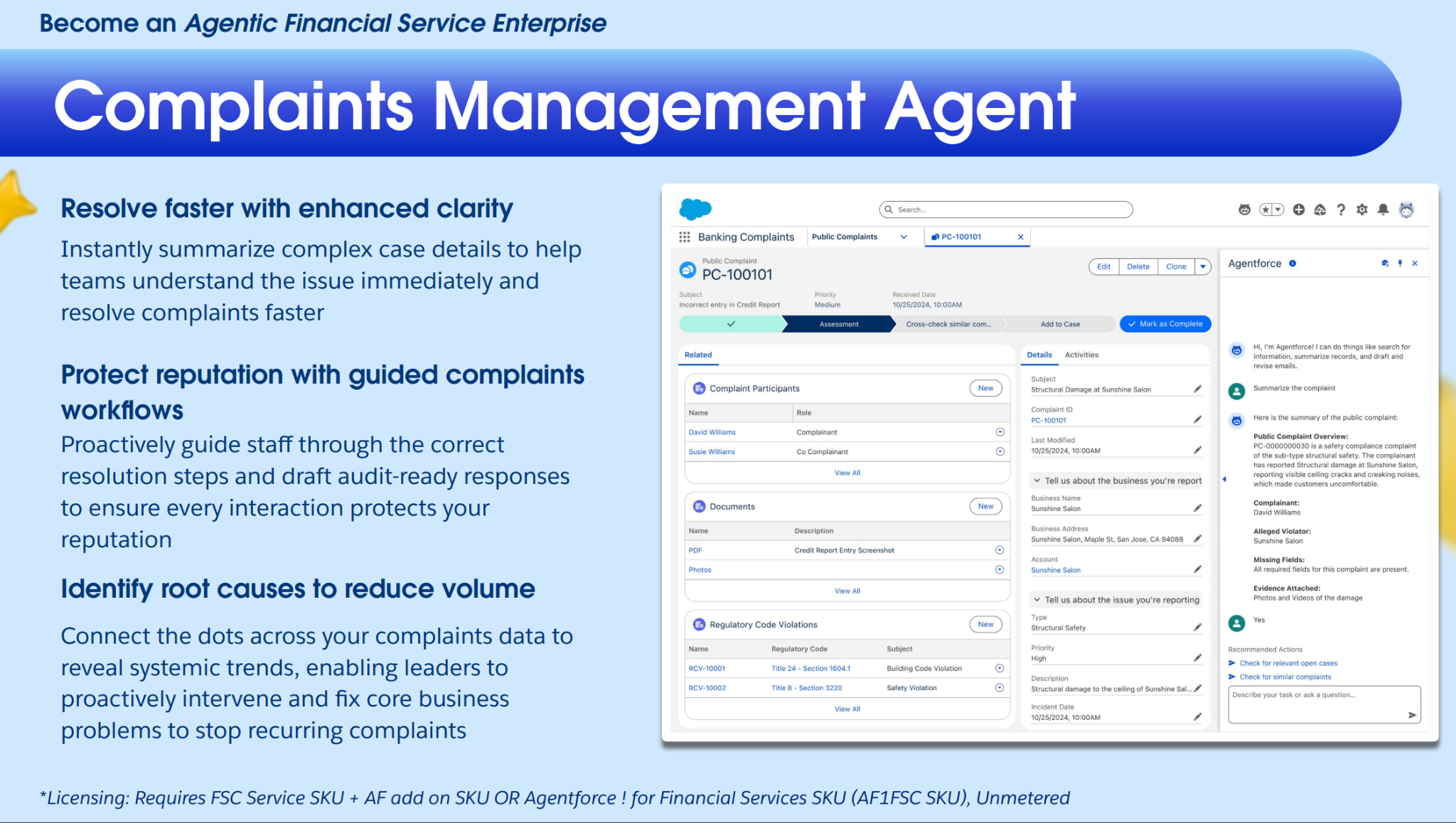
Banks and insurers can reduce investigation time, improve consistency, and identify recurring issues before they affect larger groups of customers.
Relationship Agent
Relationship management remains a critical function in wealth management and private banking. Relationship Agent helps advisors prepare for meetings by analyzing client data, identifying significant life events, highlighting portfolio opportunities, and surfacing relevant insights.
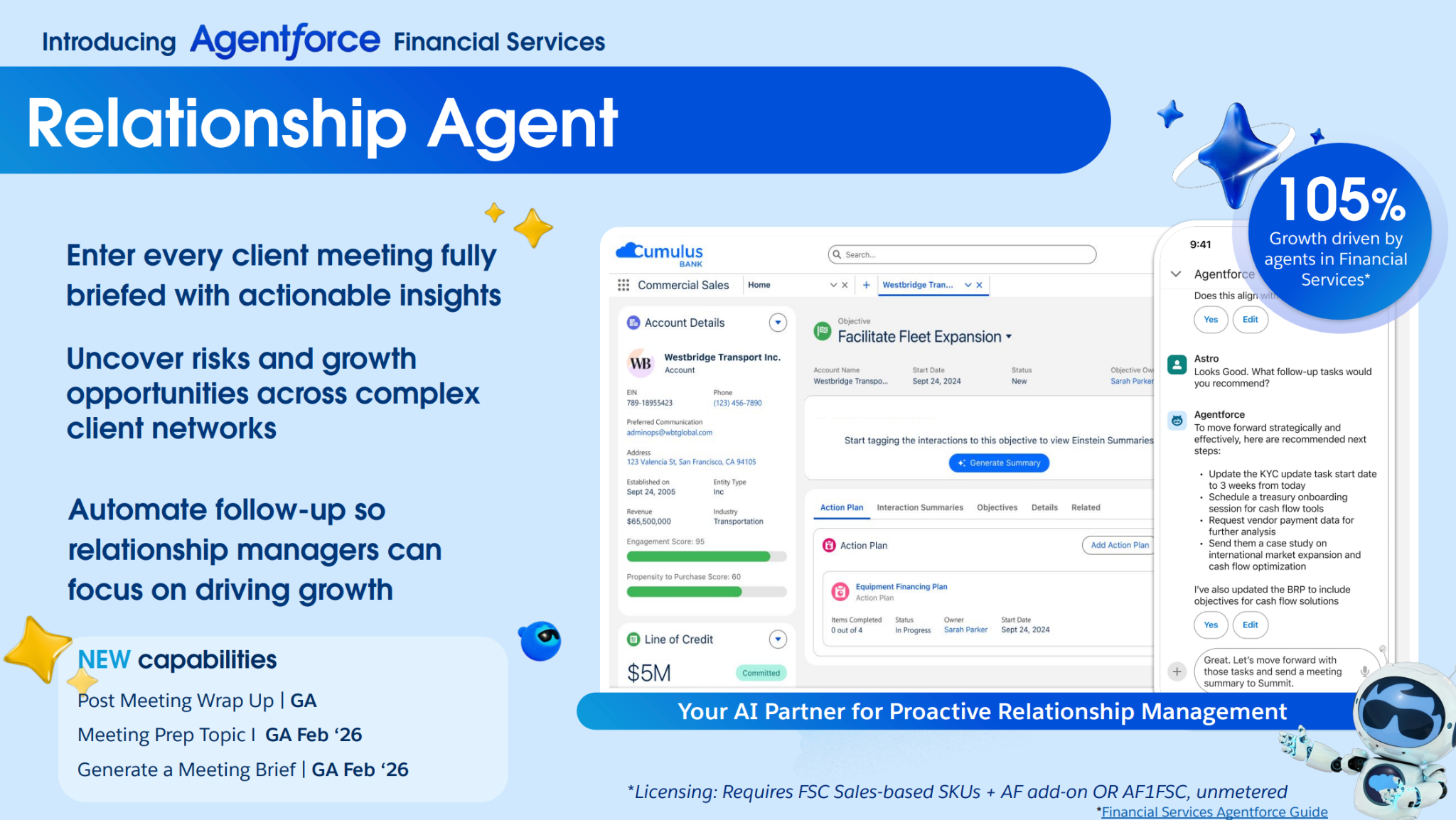
Instead of spending hours gathering information across multiple systems, advisors receive actionable recommendations that support more meaningful client conversations.
AI Self-Service Portal Agent
Many customers prefer solving issues on their own, but traditional self-service portals often create frustration because information is difficult to find or understand.
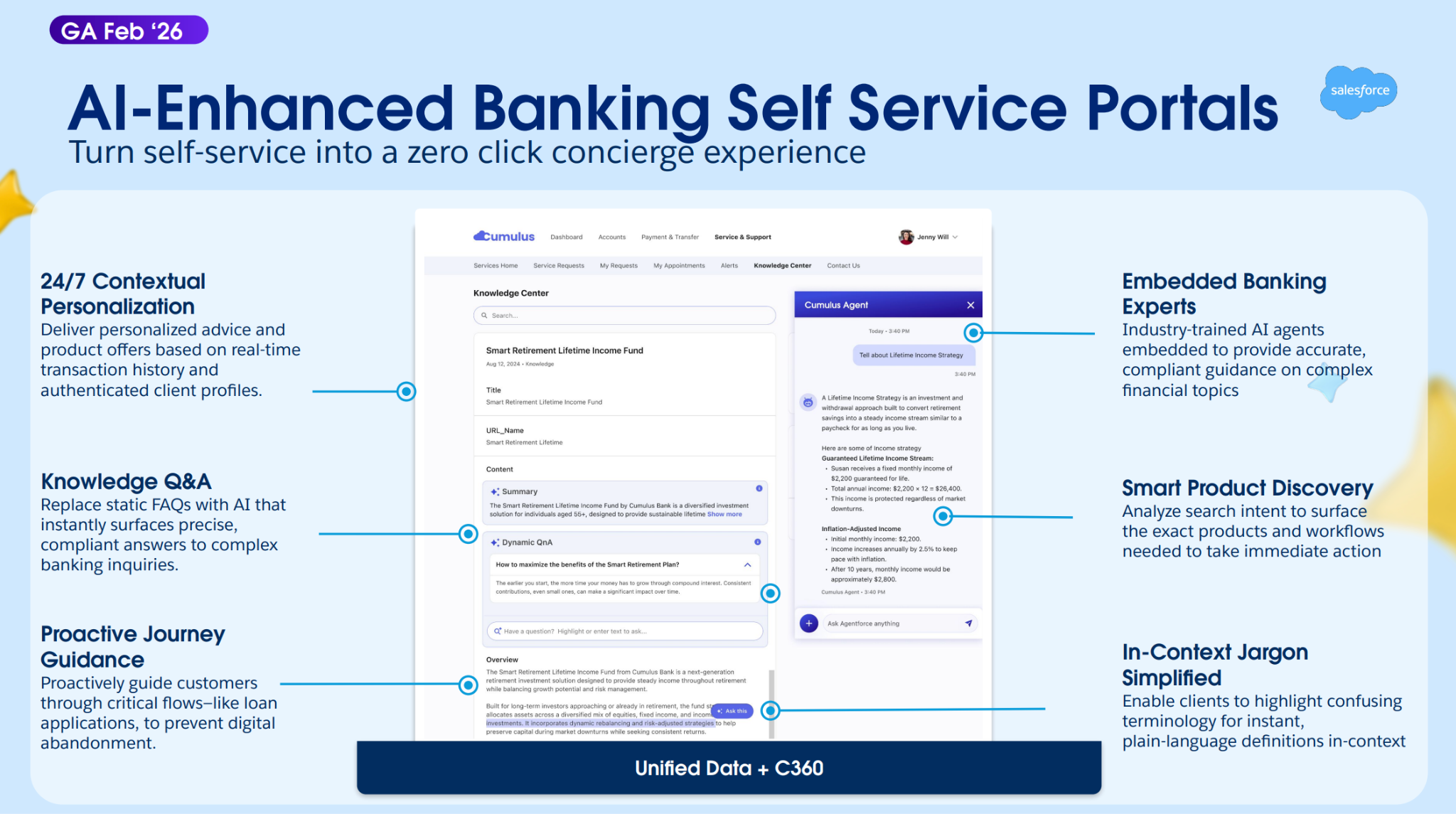
The AI Self-Service Portal Agent transforms digital service experiences by providing conversational assistance, simplifying financial terminology, answering complex questions, recommending products, and guiding customers through processes such as onboarding, applications, and service requests.
For financial institutions, higher self-service adoption often translates into lower service costs and improved customer satisfaction.
Which Agentforce AI agent should financial institutions start with?
The best starting point depends on the organization's priorities.
- Banks focused on customer service efficiency often begin with the Banking Customer Service Agent.
- Institutions managing large call volumes may prioritize the Banking Service Agent on Voice.
- Banks and insurers facing regulatory pressure frequently start with the Complaint Management Agent.
- Wealth management firms typically see the greatest value from Relationship Agent.
- Organizations pursuing digital transformation often prioritize AI-powered self-service portals.
Many institutions eventually combine multiple AI agents for financial services to create a connected service model that supports customers and employees across every channel.
AI agents in financial services: real-world use cases across banking, wealth management, and insurance
Financial institutions are increasingly adopting AI agents in financial services to automate routine work, improve customer experiences, and support employees with real-time insights. Unlike traditional chatbots, modern AI agents can access customer data, follow business processes, execute approved actions, and collaborate with human teams when additional review is required.
The use cases below demonstrate how AI agents for financial services can create value across banking, wealth management, asset management, and insurance.
Agentforce banking use cases
Banks handle thousands of customer interactions every day, many of which follow predictable workflows. AI agents can automate these requests while maintaining consistency and compliance.
Account servicing
Customers frequently contact banks to check balances, update personal information, request statements, or review account activity. AI agents can retrieve account information, answer questions, and initiate service requests without requiring human intervention.
Disputes and chargebacks
Transaction disputes often involve gathering information, validating details, and launching investigation processes. AI agents can guide customers through dispute submissions, collect supporting information, and initiate internal workflows.
Card management
Lost cards, stolen cards, card replacements, card activation, and temporary card locks are common service requests that can be handled automatically through AI-powered banking agents.
Loan application guidance
Many applicants abandon loan processes because requirements are unclear or documentation is incomplete. AI agents can guide customers through application steps, explain eligibility criteria, answer questions, and help collect required information.
Can AI agents handle banking customer service?
Yes. Modern banking AI agents can manage routine service requests such as account inquiries, card management, transaction disputes, address changes, and balance checks. More complex situations can be escalated to human employees while preserving the full conversation history and customer context.
Agentforce wealth and asset management use cases
Wealth managers and advisors spend significant time gathering information before client meetings. AI agents help reduce preparation time while improving the quality of client interactions.
Advisor preparation
AI agents can analyze account activity, portfolio performance, recent communications, and client goals to prepare advisors before meetings.
Relationship summaries
Instead of reviewing information across multiple systems, advisors can receive a consolidated overview of household relationships, assets, investment preferences, service history, and opportunities for engagement.
Client onboarding
New client onboarding often requires document collection, identity verification, compliance checks, and multiple stakeholder interactions. AI agents can coordinate these activities and guide clients through each stage of the process.
Meeting preparation
Before important reviews, AI agents can generate personalized meeting briefs that highlight portfolio changes, upcoming milestones, service issues, and recommended discussion topics.
Agentforce for insurance
Insurance organizations face many of the same service and compliance challenges as banks, but with additional complexity around claims processing, policy management, and broker relationships.
Claims intake
AI agents can guide policyholders through claims submissions, collect required information, validate documentation, and initiate claims workflows.
Policy servicing
Customers often need assistance updating beneficiaries, changing coverage details, requesting documents, or reviewing policy information. AI agents can automate many of these requests while reducing pressure on support teams.
Customer support
Insurance customers expect fast answers regarding claims status, policy coverage, payments, and eligibility. AI agents can provide immediate assistance through digital and voice channels.
Complaint resolution
Complaint Management Agents can summarize cases, identify similar complaints, suggest next steps, and help generate compliant responses for customer service teams.
Broker assistance
AI agents can support brokers by surfacing policy information, recommending products, preparing client summaries, and helping navigate internal processes.
How are AI agents used in insurance?
AI agents support claims processing, policy servicing, customer support, broker enablement, and complaint management. They help insurers respond faster, reduce administrative work, and improve customer experiences across digital and assisted service channels.
Agentforce for regulatory and compliance workflows
Compliance remains one of the most important considerations when deploying AI in financial services. Industry-specific AI agents are designed to operate within governance frameworks rather than outside them.
Audit-ready responses
AI agents can document actions, data sources, and decision paths, helping organizations maintain detailed records for internal reviews and regulatory requirements.
Compliance guardrails
Business rules, security controls, and regulatory policies can be embedded directly into agent workflows to prevent unauthorized actions.
Escalation controls
When requests exceed predefined authority levels or require specialist review, AI agents can automatically transfer cases to qualified employees.
Human approvals
Certain activities may require manual authorization before execution. AI agents can prepare recommendations, collect supporting information, and route requests through approval processes.
Are AI agents compliant with financial regulations?
AI agents can support regulatory compliance when deployed with appropriate controls. Platforms such as Salesforce Agentforce include security frameworks, audit capabilities, approval processes, escalation mechanisms, and governance controls that help financial institutions meet regulatory requirements while safely adopting AI.
Benefits of Agentforce for Financial Services
The value of Agentforce for Financial Services extends beyond automation. Financial institutions are using AI agents to reduce service costs, improve customer experiences, support employees, and increase operational capacity without expanding teams. By combining AI agents, Financial Services Cloud, Data Cloud, and compliance controls, organizations can deliver faster and more consistent experiences across every customer touchpoint.
1. Deliver faster customer service without adding headcount
Customer expectations continue to rise while service teams face growing volumes of requests. Agentforce helps financial institutions handle routine interactions automatically, allowing employees to focus on higher-value conversations.
Banking Customer Service Agents can process account inquiries, card replacements, transaction disputes, fee reversals, and fund transfers without requiring human involvement. Voice agents extend those capabilities to phone channels, providing support around the clock.
For many organizations, the result is lower call volumes, reduced wait times, and greater service capacity without hiring additional staff. Salesforce positions these AI agents as a way to deliver 24/7 service availability while maintaining operational resiliency during periods of high demand.
2. Increase customer satisfaction and retention
Customers want quick answers, personalized recommendations, and seamless experiences across channels. AI agents financial services organizations deploy through Agentforce can access customer profiles, account history, relationships, and previous interactions to provide more relevant support.
Instead of navigating complex menus or waiting for an available representative, customers receive immediate assistance tailored to their situation. Faster response times and personalized interactions often contribute to stronger customer loyalty and higher satisfaction scores.
Agentforce also supports consistent experiences across self-service portals, chat, messaging, voice, and service teams, helping institutions build trust at every stage of the customer journey.
3. Shorten complaint resolution cycles
Complaint management is often one of the most time-consuming processes in banking and insurance. Employees must review case histories, identify relevant information, investigate root causes, and prepare compliant responses.
Agentforce helps accelerate this process by summarizing complaints, identifying similar cases, suggesting next steps, and supporting response preparation. Teams spend less time searching for information and more time resolving customer issues.
Faster resolutions can reduce operational costs, improve customer experiences, and help organizations identify recurring problems before they affect larger groups of customers.
4. Help advisors and service teams accomplish more
Relationship managers, financial advisors, and service representatives spend a significant portion of their day preparing for meetings, reviewing customer information, and gathering data from multiple systems.
Agentforce can generate relationship summaries, surface client insights, identify service opportunities, and prepare meeting briefs automatically. Advisors gain immediate access to relevant information instead of manually compiling it from various sources.
Service teams also benefit from AI-generated recommendations, faster access to knowledge, and automated administrative tasks. The result is more productive employees who can spend more time delivering value to customers.
5. Strengthen trust with built-in security and compliance controls
Financial institutions cannot afford uncontrolled AI adoption. Regulatory obligations, customer privacy requirements, and risk management policies demand strict governance.
Agentforce was designed with trust and compliance in mind. The platform includes guardrails that help control how AI agents access data, execute actions, and interact with customers. Audit trails, escalation paths, approval workflows, and human handoff mechanisms help organizations maintain oversight of every interaction.
Rather than replacing compliance processes, Agentforce operates within them. Financial institutions can automate customer-facing and internal workflows while maintaining the transparency and control required in highly regulated environments.
Looking to implement Agentforce for Financial Services?
Deploying AI agents in financial services requires more than enabling a new Salesforce feature. Success depends on data quality, security controls, customer journeys, integration architecture, and compliance requirements specific to your organization.
At Noltic, we help financial institutions design, implement, and optimize Salesforce solutions that deliver measurable business outcomes. As a Salesforce Summit Partner with deep expertise in Financial Services Cloud, Data Cloud, Agentforce, Revenue Cloud, and complex enterprise integrations, our team helps organizations move from AI experimentation to real business value.
Whether you're exploring Agentforce for Financial Services for the first time or planning a large-scale rollout across banking, wealth management, or insurance operations, we can help you:
- Identify the best AI agent use cases for your organization
- Prepare Financial Services Cloud and Data Cloud foundations
- Integrate Agentforce with core banking, policy, and third-party systems
- Establish governance, security, and compliance controls
- Design customer service and advisor workflows
- Scale AI adoption across teams and channels
Our team has delivered 160+ Salesforce projects across regulated industries, helping organizations improve customer experiences, automate operations, and build scalable digital service models.
Frequently asked questions about Agentforce for Financial Services
What is Agentforce for Financial Services?
Agentforce for Financial Services is Salesforce's industry-specific AI platform for banks, credit unions, wealth managers, asset management firms, and insurance providers. It combines autonomous AI agents, Financial Services Cloud, Data Cloud, and the Einstein Trust Layer to automate customer service, onboarding, relationship management, complaints handling, and other financial services processes.
How does Salesforce Agentforce for Financial Services work?
Salesforce Agentforce for Financial Services connects AI agents to customer data, business workflows, CRM records, and external systems. The agents can understand customer requests, retrieve information, perform approved actions, and escalate interactions to human employees when required. Security controls, audit trails, and governance policies help ensure AI operates within organizational and regulatory requirements.
What are the best AI agents for financial services?
Some of the most notable AI agents for financial services introduced by Salesforce include the Banking Customer Service Agent, Banking Service Agent on Voice, Complaint Management Agent, Relationship Agent, and AI Self-Service Portal Agent. Each is designed for specific financial services workflows, helping organizations improve efficiency, customer experiences, and employee productivity.
Can Agentforce be used by banks and credit unions?
Yes. Agentforce is designed for a wide range of financial institutions, including retail banks, commercial banks, digital banks, and credit unions. Common use cases include account servicing, card management, dispute resolution, customer support, self-service experiences, onboarding, and relationship management.
How does Agentforce for insurance support claims and policy servicing?
Agentforce for insurance can automate claims intake, guide policyholders through claims submissions, provide policy information, support customer service teams, and assist with complaint resolution. AI agents can also help brokers and service representatives access relevant customer information and complete routine service tasks more efficiently.
Is Agentforce compliant with financial services regulations?
Agentforce was designed to support organizations operating in regulated industries. The platform includes security controls, auditability, compliance guardrails, approval workflows, escalation mechanisms, and human handoff capabilities. Regulatory compliance ultimately depends on how the solution is configured and governed within each organization.
What is Agentforce 360 for Financial Services?
Agentforce 360 for Financial Services combines Financial Services Cloud, Data Cloud, Agentforce, and the Einstein Trust Layer into a unified AI platform. It gives AI agents access to customer relationships, financial accounts, interaction history, and operational data, allowing them to provide personalized assistance and complete business processes more effectively.
Do AI agents replace financial advisors and service representatives?
No. AI agents are designed to support employees rather than replace them. They handle repetitive requests, administrative work, and routine customer interactions, allowing advisors and service teams to focus on complex cases, relationship building, financial planning, and strategic decision-making.
How much does Agentforce for Financial Services cost?
Agentforce for Financial Services pricing depends on licensing requirements, Salesforce products already in use, the number of AI agents deployed, expected usage volumes, and implementation complexity. Most organizations should expect to combine Financial Services Cloud licensing with Agentforce-related licensing and implementation services. Consulting with a Salesforce partner is often the best way to estimate total costs for a specific use case.
What is the difference between AI chatbots and AI agents in financial services?
Traditional AI chatbots primarily answer questions and provide information. AI agents can go much further by accessing customer records, following business rules, executing approved actions, initiating workflows, and collaborating with human employees. In financial services, that difference allows AI agents to resolve requests rather than simply explain how customers should complete them.


.webp)

The ultimate guide to Salesforce Financial Services Cloud

Agentforce for sales, service, and marketing: a full guide
together